Serpentine Spring Couplings
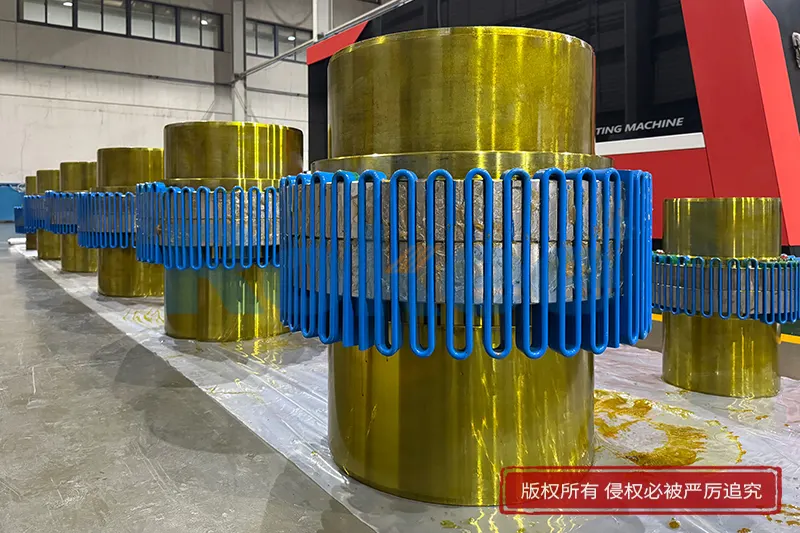
Serpentine Spring Couplings (Grid Couplings) – heavy-duty metal flexible couplings for torque transmission. Absorb shock & vibration, compensate shaft misalignment, easy install. JS series for mining, pumps, fans & conveyors. Rokee is a serpentine spring couplings supplier in China. We support custom orders and offer direct factory sales, providing reliable products with flexible solutions for global clients.
Serpentine spring couplings are flexible power transmission components that transfer torque between rotating shafts. With toothed hubs, a wave-shaped spring strip and protective housing as core parts, they rely on the spring’s elastic deformation to accommodate shaft misalignment and absorb shock loads. Featuring high torque density and vibration damping capacity, they outperform many elastomeric couplings in oil and high-temperature resistance. Widely used for pumps, conveyors and heavy industrial machinery, they demand correct alignment, lubrication and regular inspection for stable operation.
Serpentine spring couplings are a type of flexible mechanical coupling designed to transmit torque between two rotating shafts while accommodating misalignment and mitigating shock loads. They rely on a specially shaped serpentine spring element as the core load-bearing and flexible component, distinguishing them from elastomeric, gear, and disc couplings. The design balances torsional flexibility and high torque capacity, making it a reliable connecting component for rotating power transmission systems. This coupling configuration offers a middle ground between rigid couplings and highly flexible soft couplings, with stable performance under fluctuating load conditions.
Classification and Common Models
Serpentine spring couplings can be grouped according to structural layout and assembly form. The primary categories include basic horizontal split casing type, sealed enclosed type, and compact short-bore type. The split casing variant allows convenient inspection and replacement of the spring element without full disassembly of connected equipment. Enclosed versions feature a closed housing structure to shield internal parts from external contaminants. Compact models are engineered for installation spaces with strict axial dimension limits.
Common model series follow standardized dimensional frameworks differentiated by rated torque range, shaft bore capacity, and allowable misalignment parameters. Each model series covers a continuous torque spectrum to match low, medium and heavy-duty transmission demands. Model identifiers generally reflect structural form and torque grade rather than tied to proprietary brand naming rules.
Structural Composition and Materials
A typical serpentine spring coupling assembly consists of four major parts: two toothed hubs, a serpentine spring strip, a protective housing, and auxiliary fasteners. The hubs are machined with curved tooth profiles that mesh with the wave-shaped contour of the serpentine spring. The housing wraps around the spring and meshing tooth area, retaining lubricant and providing physical protection. Fasteners secure the housing halves and maintain assembly integrity.
Hub materials are commonly high-strength carbon steel or alloy steel, selected for good hardness and wear resistance after heat treatment. The serpentine spring is fabricated from high-quality spring steel with controlled tempering processes to secure consistent elasticity and fatigue resistance. Housing components may use cast iron or steel plate depending on operating load and protection requirements. Lubricants applied inside the housing are suitable for sliding contact between spring and tooth surfaces.
Working Principle
Torque transfer depends on the engagement between the curved teeth of the two hubs and the serpentine spring. When the driving hub rotates, tooth surfaces push against the segments of the serpentine spring, and the spring sequentially transfers rotational force to the driven hub. The wave geometry of the spring permits controlled elastic deformation during operation.
When parallel, angular or axial misalignment exists between the two shafts, the serpentine spring flexes locally to compensate for the offset. Under sudden shock or peak overload, the spring deforms further to absorb impact energy rather than passing sharp load spikes directly to connected bearings and shafts. Contact between spring and tooth surfaces involves slight sliding motion, which requires lubrication to reduce friction and wear.
Features and Advantages
One prominent advantage is high torque density within a relatively compact envelope, enabling transmission of heavy loads without excessive coupling size. The torsional flexibility effectively dampens torsional vibration and shock from reciprocating equipment or variable load sources. It can simultaneously accommodate angular, parallel and axial misalignment, easing strict alignment requirements during installation.
The coupling maintains good torsional stiffness under steady normal loads while retaining cushioning capacity for transient peak loads. Wear of the spring element is gradual, and visual inspection can assess service condition for planned replacement. Compared with gear couplings, the structure has fewer precision-machined surfaces. Unlike elastomeric couplings, its flexible element does not suffer from rapid aging caused by high temperature or oil exposure.
Limitations should also be noted. It requires proper lubrication for normal service life. Performance will degrade if misalignment exceeds the allowable range. The coupling is not suited for applications demanding extremely high torsional flexibility.
Applicable Conditions and Application Industries
Suitable operating conditions include steady rotation with intermittent shock loading, moderate rotational speed, and environments where shaft misalignment cannot be fully eliminated. It performs well in systems with cyclic load variation, where vibration damping is necessary to protect adjacent machinery.
It is widely adopted in material handling equipment, heavy conveying systems, industrial fans and blowers, pump sets, compressors, and general heavy-duty gear drive arrangements. It also sees frequent use in mining auxiliary machinery, cement production equipment, paper processing machinery, and steel plant auxiliary transmission lines. It is less suitable for high-speed precision spindles or equipment working in dry, abrasive environments without adequate sealing protection.
Installation and Commissioning Points
Before installation, all mating surfaces, hub bores, tooth profiles and the serpentine spring must be cleaned to remove machining debris, rust and foreign particles. The two hubs are mounted separately on the driving and driven shafts, and axial positioning is adjusted to leave the designated gap between hub end faces.
Shaft alignment is carried out to bring misalignment values within the permissible range. Both dial indicator measurement and straightedge checking methods can be used to verify parallel and angular offset. After alignment, the serpentine spring is fitted into the meshing tooth grooves, followed by closing and fastening the housing. Lubricant is added to the internal cavity to cover the contact zone of spring and teeth.
Commissioning starts with no-load trial operation. Operators check for abnormal noise, vibration or housing temperature rise. After a short no-load run, the coupling is put under partial load, and alignment and lubrication status are rechecked. If excessive heating or knocking sound occurs, the equipment should be shut down to readjust alignment or replenish lubricant.
Selection and Customization
Selection begins with confirmation of the normal operating torque and peak torque of the transmission system. A service factor is applied according to load fluctuation severity to determine the required coupling torque rating. Next, the maximum shaft diameters of driving and driven sides, available installation length, rotational speed, and expected misalignment level are confirmed. Ambient temperature and surrounding medium are also considered to verify material and lubricant compatibility.
When standard models cannot satisfy requirements, customized solutions are available. Customizable items include modified hub bore dimensions, special hub connection forms, adjusted housing sealing structures, and non-standard spring parameters for unique torsional flexibility targets. Custom requests are constrained by the fundamental mechanical limits of the serpentine spring structure.
Operation and Maintenance
Routine maintenance consists of periodic visual inspection, lubricant replenishment or replacement, and misalignment rechecking. During regular shutdown intervals, the housing can be opened to examine the surface condition of the serpentine spring and tooth contact areas. Signs of heavy scoring, crack formation or permanent deformation of the spring indicate that replacement is needed.
Lubricant will degrade over time due to heat and shear, so scheduled renewal prevents accelerated wear. Fasteners of the housing should be checked for loosening. After equipment overhaul or foundation settlement, shaft alignment must be remeasured and corrected.
Overload operation should be avoided continuously, as repeated excessive peak loads shorten spring fatigue life. If the coupling runs with persistent abnormal vibration, the root cause, such as shaft displacement or spring damage, should be identified promptly. Proper maintenance extends service life and prevents unexpected breakdown of the whole power transmission chain.