Steel Laminae Coupling For Electrical Machinery

Steel Laminae Coupling For Electrical Machinery. Backlash-free, maintenance-free flexible disc coupling for motors & generators. Compensate shaft misalignment, high torque, custom sizes available. Rokee is a steel laminae coupling for electrical machinery supplier in China. We support custom orders and offer direct factory sales, providing reliable products with flexible solutions for global clients.
Steel laminae coupling is a flexible shaft connector designed for power transmission of electric machinery. It mainly consists of hubs, stacked steel laminae, bolts and spacing sleeves, adopting high-strength alloy steel and structural steel as core materials. It transmits torque through elastic micro-deformation of steel laminae to compensate shaft misalignment, absorb impact loads and reduce extra bearing stress. Featuring high-speed stability, low backlash and no friction wear, it suits continuous rotation of motors matched with pumps, fans and compressors. Proper alignment, regular inspection and timely replacement of damaged laminae are required for reliable operation.
-
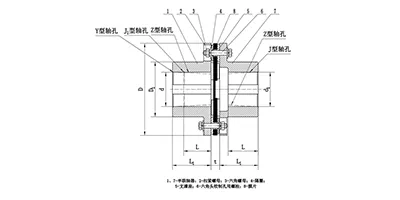
JMI Diaphragm Coupling
Single-section with Counterbore
The JMI diaphragm coupling adopts a single-section design and is suitable for applications with a short transmission distance. One half-coupling hub is provided with a counterbore to facilitate shaft end fixation. -
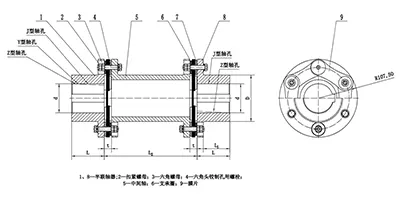
JMIJ Diaphragm Coupling
With Intermediate Shaft and Counterbore
The JMIJ diaphragm coupling features an intermediate shaft design, suitable for applications requiring a long transmission distance. One half-coupling hub is provided with a counterbore to facilitate shaft end fixation. -
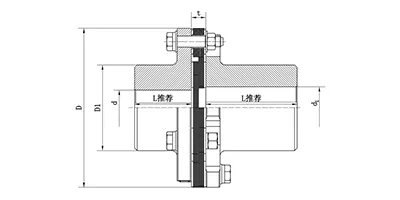
JMII Diaphragm Coupling
Single-section without Counterbore
The JMII diaphragm coupling adopts a single-section design without counterbore. It is suitable for applications with an even shorter transmission distance and features a more compact structure. -
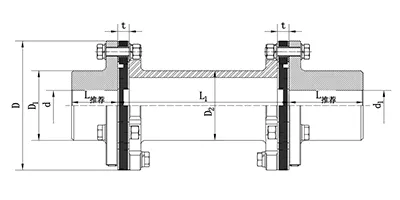
JMIIJ Diaphragm Coupling
With Intermediate Shaft and without Counterbore
The JMIIJ diaphragm coupling adopts an intermediate shaft design, suitable for applications with a long transmission distance. Neither of the two half-coupling hubs is provided with a counterbore. -
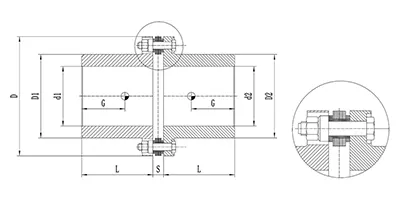
RLM Standard Small Single Diaphragm Coupling
Standard Single-Span Small
The RLM standard single-span small metal diaphragm coupling is suitable for various industrial process pumps and low-torque applications with an operating speed not exceeding 5000 rpm. It cannot compensate for radial misalignment. -
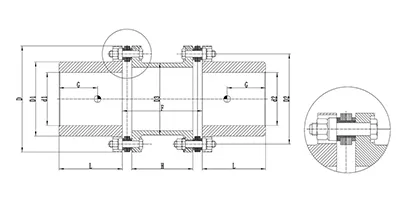
RLMD Standard Small Double Diaphragm Coupling
Standard Double-Span Small
The RLMD standard double-span small metal diaphragm coupling is suitable for various industrial process pumps and low-torque applications with an operating speed not exceeding 5000 rpm. -
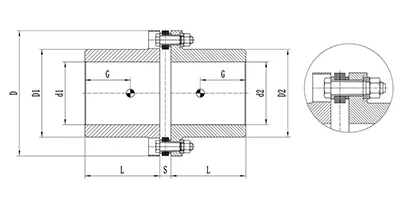
RLA Standard Single Diaphragm Coupling
Standard Single-Span
A classic design of metal flexible diaphragm coupling, a reliable choice for medium and low speed applications, but incapable of compensating for radial misalignment. -
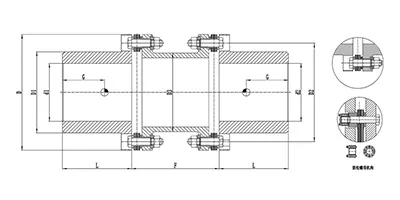
RLAD Standard Double Diaphragm Coupling
Standard Double-Span
A classic design of metal flexible diaphragm coupling and a reliable choice for medium and low speed applications. -
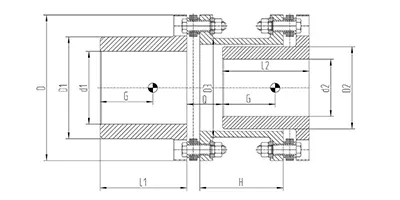
RLAR Single-Hub Reverse-Mounted Diaphragm Coupling
Single-Hub Reverse-Mounted
The RLAR metal diaphragm coupling features a single-side hub reverse mounting design for applications with limited shaft end spacing. -
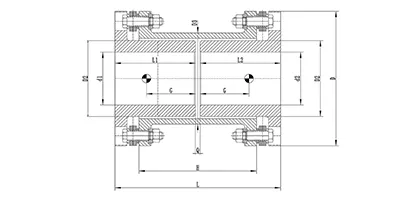
RLARD Dual-Hub Reverse-Mounted Diaphragm Coupling
Dual-Hub Reverse-Mounted
The RLARD diaphragm coupling adopts a double-side hub reverse mounting design. It is also suitable for applications with limited shaft end spacing or requiring lower additional bending moment. -
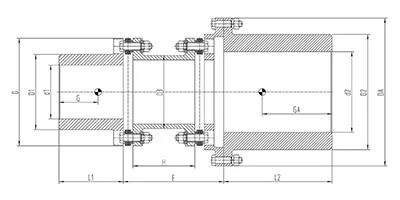
RLAF Different Bore Diaphragm Coupling
Different Bore
The RLAF different bore metal diaphragm coupling adopts a design with dissimilar hub bore sizes on both sides, suitable for applications where the shaft diameters at the two ends differ greatly. -
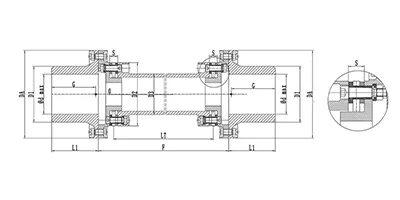
RLAT Extra Long Spacing Diaphragm Coupling
Extra Long Spacing
The RLAT extra long spacing diaphragm coupling adopts an intermediate shaft design, suitable for power transmission applications with extra-long shaft separation. -
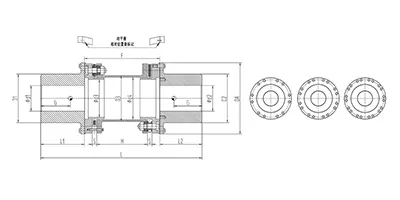
RLQA Flexible Diaphragm Coupling
Flangeless Quick-Mount
The RLQA flangeless quick-mount diaphragm coupling is suitable for medium and low speed applications such as various industrial process pumps and fans, with a general operating speed not exceeding 25000 rpm. -
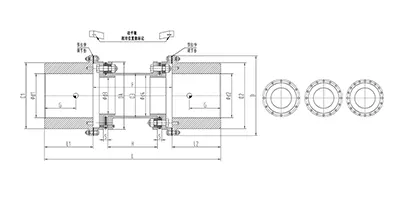
RLQF Flanged Quick-Mount Diaphragm Coupling
Flanged Quick-Mount
RLQF flanged quick-mount flexible diaphragm coupling suitable for blowers, turbo compressors and other high-speed applications, operating speed up to 35000 rpm. -
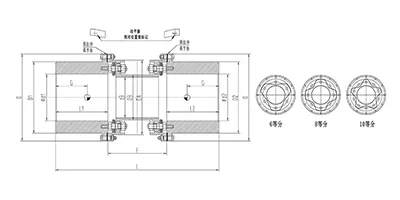
RLQU Flanged Diaphragm Coupling
Improved Flanged Quick-Mount
RLQU Improved Flanged Diaphragm Coupling features lower additional bending moment and enhanced service performance. Suitable for blowers, turbo compressors and other high-speed applications. -
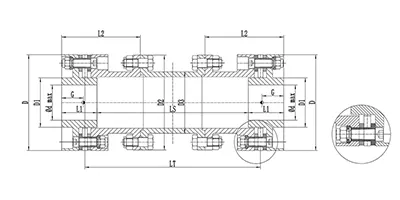
RLHD High-Speed Diaphragm Coupling
High-Speed
The RLHD high-speed diaphragm coupling is designed for higher-speed applications. It also features an integrated assembly design of flexible components, with operating speed up to 42000 rpm.
A steel laminae coupling is a flexible shaft connection component specially developed for power transmission between electric machinery and matched driven equipment. It serves as an intermediate link that transfers rotary torque while accommodating minor relative displacements between connected shafts. Unlike rigid coupling structures, this coupling relies on elastic deformation of thin metal components to realize flexible compensation, and it has been widely adopted in various power transmission systems centered on electric motors. The whole assembly operates without sliding contact between internal parts, eliminating the need for contact-type friction transmission during normal operation. It can maintain stable power delivery under continuous rotation and variable load conditions, and effectively buffer transient impact loads generated during motor startup, shutdown and load fluctuation.
Structural Composition and Materials
The basic assembly of a steel laminae coupling mainly consists of two hub bodies, multiple groups of steel laminae sets, fastening bolt assemblies and spacing sleeves. The hubs are mounted respectively on the shaft ends of the driving electric machine and the driven equipment, providing positioning and torque transfer bases. The steel laminae sets are stacked thin metal sheets arranged in a specific layout, which form the core flexible unit of the coupling. Fastening bolts penetrate the laminae groups and hub flanges to lock all components together, and spacing sleeves control the clearance between adjacent laminae and maintain the correct assembly spacing.
The primary material for the laminae is high-strength alloy steel with excellent fatigue resistance, which is processed through precision cutting and surface treatment to guarantee stable elastic performance after repeated deformation. Hub components generally adopt medium carbon structural steel, processed to achieve good strength and machining accuracy. Fasteners are made of high tensile strength steel to resist shear and tension forces under long-term torque load. Auxiliary spacer parts use steel materials with stable dimensional performance to avoid deformation under working temperature changes. No elastic rubber or polymer sealing elements are used in the torque transfer path of the standard structure.
Working Principle
When the electric machinery starts to rotate, torque is transmitted from the driving shaft hub to the stacked steel laminae through the fastening bolts. The laminae groups bear tension and micro bending deformation as the rotation proceeds, and then transfer torque to the driven side hub to drive the matched equipment to rotate synchronously.
When parallel offset, angular deviation or axial displacement exists between the two connected shafts, the steel laminae produce controlled elastic deformation to absorb these misalignments. Such deformation allows the coupling to compensate for the relative shaft displacement without generating extra constraining force that would impose heavy additional load on the motor bearing and shaft system. Under transient impact or fluctuating torque, the elastic deformation of the laminae can absorb part of the impact energy and smooth the sudden change of transmission load. The coupling maintains synchronous rotation of the two shafts at all times, and there is no relative sliding between the steel laminae and connecting bolts in normal working conditions. Once the external load returns to the steady state and shaft misalignment stays within the allowable range, the laminae will rebound to their original shape.
Features and Advantages
This type of coupling delivers outstanding transmission stability under high rotating speed conditions. Its flexible compensation capacity can reduce extra bearing load caused by installation deviation and thermal expansion displacement of the motor and connected equipment. Since there are no wearing friction pairs inside the torque transmission path, it avoids abrasion powder generation and performance degradation from friction wear.
It possesses high torque density and compact overall structure, occupying less axial installation space compared with many other flexible coupling forms. The steel laminae have stable performance across a wide temperature range, and will not suffer aging, softening or hardening failure that commonly occurs to elastic polymer parts. The coupling runs with low rotary backlash, which is suitable for transmission occasions requiring precise rotation response. It also produces low vibration transfer and low noise during continuous operation. The design allows convenient inspection of the laminae without complete disassembly of the whole shaft system in most cases. The failure mode of the laminae is gradual fatigue crack expansion rather than sudden fragmentation, which leaves a window for routine inspection and replacement.
Applicable Working Conditions and Application Industries
The coupling adapts to continuous rotating working conditions with steady or periodically fluctuating torque. It can operate under medium and high rotational speeds, and tolerates limited angular, parallel and axial misalignment between coupled shafts. It is fit for environments with ambient temperature changes, dry air, and general industrial atmospheric conditions. It is not suitable for scenarios with strong corrosive medium immersion, heavy particle abrasive dust continuously scouring the laminae, or excessive shaft misalignment exceeding the compensation capacity.
Common application scenarios cover power transmission systems with supporting electric machinery in many industrial sectors. It is used for motor connection with pumps, fans and blowers, as well as driving systems of compressors and light-duty transmission machinery. It is also applied in material handling equipment, general processing machinery and auxiliary power units of industrial facilities. It can be configured for both constant-speed operation and frequent start-stop cycles within the allowable load range.
Installation and Commissioning Points
Before installation, the shaft end surfaces, inner bores of hubs and matching keyway surfaces should be cleaned thoroughly to remove burrs, rust and residual machining debris. The two hubs are installed onto the driving and driven shafts respectively, and the positioning length and coaxial preliminary alignment are adjusted. The steel laminae packs and spacing sleeves are assembled in the designated sequence, and fastening bolts are fitted in place.
Alignment work is the key step in commissioning. Radial runout and angular deviation of the two hubs must be measured and adjusted to keep misalignment within the permitted range. Uneven bolt tightening force will cause abnormal stress distribution on the laminae, so all bolts need to be tightened in a symmetrical sequence to reach uniform preload. After preliminary assembly, manual rotation of the shaft system is required to check for jamming, abnormal resistance or local interference. A no-load test run with the electric machinery is carried out after installation, to observe abnormal vibration, unusual noise and temperature rise at the coupling position. Load can be gradually applied only after the no-load running state remains stable. If obvious vibration appears during test, the shaft alignment status shall be rechecked preferentially.
Selection and Customization
The basic selection starts with confirming the rated working torque of the electric machinery, the maximum transient torque during startup and impact, and the continuous operating speed. The installation distance between the two shaft ends, shaft diameter sizes of both sides and allowable space layout are also essential reference parameters. The required compensation capacity for shaft misalignment should be evaluated according to installation accuracy and thermal expansion characteristics of the equipment.
Customized modification can be provided for specific application requirements. Adjustment can be made to the quantity and stacking layout of steel laminae to match different torque levels. The hub structure, bore form and connecting flange size can be adapted to special shaft end dimensions. Surface treatment schemes for laminae and metal components can be optimized for environments with higher humidity or mild corrosive atmosphere. Special balance processing can be arranged for products used in ultra-high speed transmission systems. Any customized design needs to keep the working load and misalignment within the bearing capacity of the laminae group.
Operation and Maintenance
Daily maintenance mainly includes regular visual inspection of the steel laminae sets. Operators should check for surface cracks, deformation, corrosion marks or loosening of fastening components during scheduled shutdown periods. The vibration and noise status of the coupling can be monitored during equipment operation as an indirect judgment basis of working condition.
Excessive shaft misalignment caused by foundation settlement, support structure deformation or bearing wear should be corrected timely, because long-term over-limit deviation will accelerate fatigue damage of laminae. When laminae show visible cracks, permanent bending deformation or corrosion thinning, the whole laminae pack needs to be replaced promptly. After replacement, shaft alignment and bolt pre-tightening shall be rechecked. Grease or lubricant is not required for the laminae transmission part. Avoid applying impact load on the coupling during hoisting and maintenance. Record the running duration and inspection results to formulate a reasonable replacement cycle according to actual service load. Damaged fasteners must be replaced with matched fastener components instead of reused.