Small Precision Universal Joint
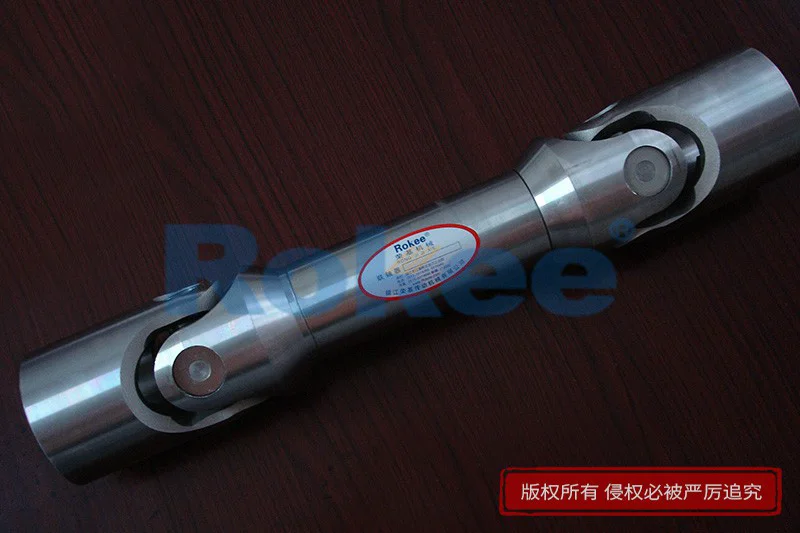
Small Precision Universal Joint, compact low-backlash u-joint for angular torque transmission. Stainless & alloy steel, single/double type, custom bore & keyway available. Rokee is a small precision universal joint supplier in China. We support custom orders and offer direct factory sales, providing reliable products with flexible solutions for global clients.
A small precision universal joint is a compact torque transmission component designed to connect two rotating shafts whose centerlines are not perfectly collinear. It enables stable power transfer while accommodating angular misalignment between driving and driven ends. Differing from heavy-duty general-purpose universal joints, this variant prioritizes miniaturized dimensions, high rotational accuracy and low backlash, making it fit for space-limited transmission loops that demand precise motion synchronization. It is widely adopted as a flexible coupling element to bridge offset shafts and compensate for minor assembly deviations in motion systems.
-
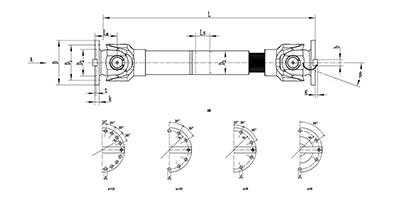
SWC-BH Cardan Shaft
Standard telescopic welded
SWC-BH universal shaft coupling with integral fork head, welded pipe structure and spline telescopic function. It compensates angular deflection and axial displacement for torque transmission, widely used in metallurgy, rolling mills and heavy machinery. -
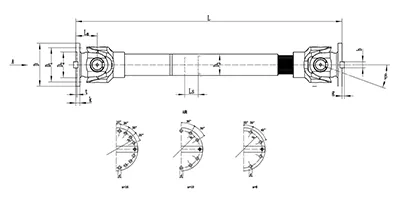
SWC-CH Cardan Shaft
long telescopic welded
SWC-CH long telescopic welded cross-shaft universal coupling adopts integral yoke structure, delivering reliable power transmission with both angular and long-range axial compensation. -
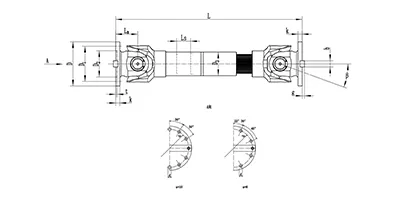
SWC-DH Cardan Shaft
Short Telescopic Welded
SWC-DH cross shaft universal coupling adopts integral yoke & welded pipe structure, featuring short telescopic spline for small axial displacement compensation. It allows large working angle, transmits torque steadily and efficiently, ideal for heavy industrial drives where shaft misalignment exists. -
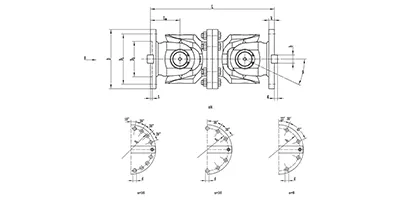
SWC-WD Cardan Shaft
Non-telescopic Short
SWC-WD cross shaft universal coupling is a non-telescopic short structure cardan coupling. It can only compensate angular displacement, features compact size, stable torque transfer and large allowable working angle, suitable for heavy-duty transmission systems with no axial movement requirement. -
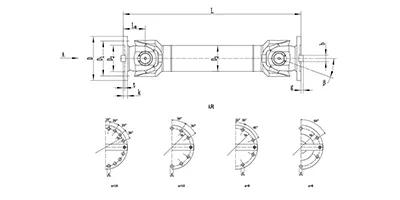
SWC-WH Cardan Shaft
Non-telescopic Welded
SWC-WH cross shaft universal joint coupling adopts welded pipe structure with no telescopic spline. It only compensates angular displacement, delivers stable torque transmission and allows large working angle. Suitable for heavy-duty drive systems where axial displacement is not needed. -
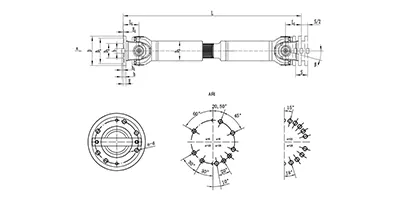
SWP-A Cardan Shaft
Long Telescopic
SWP-A type is a long telescopic cross shaft universal joint coupling (cardan shaft) with spline telescopic structure. It transmits torque between non-coaxial shafts, compensates angular deflection and axial length variation, widely used in metallurgy, lifting and other heavy machinery. -
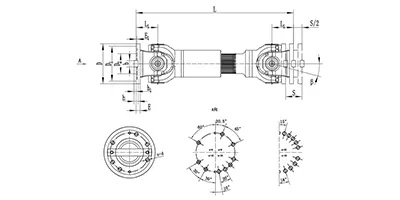
SWP-B Cardan Shaft
short telescopic
SWP-B type is a short telescopic cross shaft universal coupling (cardan shaft). Equipped with spline telescopic joint, it transfers torque between offset shafts, accommodates angular deflection and axial movement, widely used in metallurgy, mining and heavy equipment. -
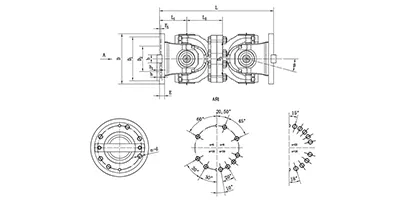
SWP-C Cardan Shaft
Non-telescopic Short
SWP-C type is a short non-telescopic cross shaft universal joint coupling (cardan drive shaft). It transmits torque between non-coaxial shafts and accommodates angular deflection only, suitable for heavy machinery with fixed axial installation distance. -
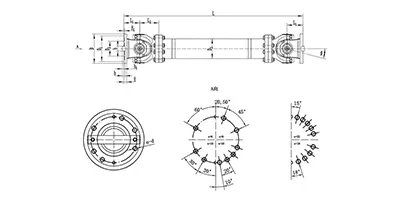
SWP-D Cardan Shaft
non-telescopic long
SWP-D non-telescopic long cross universal joint coupling adopts split bearing housing structure, transmits large torque with angular compensation, fixed overall length without axial expansion, widely applied for rolling mills and heavy transmission systems.
Structural Composition and Material
The core assembly of a small precision universal joint mainly consists of two yoke heads, a central cross-shaped spider, and connecting fasteners. Each shaft end is fixed to one yoke, and the cross spider sits in the matching bearing seats of the two yokes to form a hinged connection. Some compact versions integrate needle rollers inside the contact positions between the spider and yokes to reduce sliding friction. Common structural accessories include retaining rings and locking set screws for axial fixation.
For material selection, high-strength alloy steel is frequently used for the cross spider and yokes to guarantee rigidity and wear resistance under continuous rotation. Some surface contact areas receive hardening treatment to extend service life. Non-load-bearing auxiliary parts may adopt engineering plastics or lightweight stainless steel when corrosion resistance or weight reduction is required. Materials are chosen to balance mechanical strength, surface smoothness and dimensional stability.
Working Principle
The universal joint transmits rotational torque through the hinged cross spider. When the driving shaft rotates, the force is passed to the driven shaft via the cross member. The hinge structure permits a certain included angle between the two shafts. During operation, the instantaneous angular speed of the driven shaft fluctuates slightly if only one single universal joint is used. To achieve near-constant velocity output, two small precision universal joints are often arranged in pairs, with the angular misalignment angles matched properly to counteract the speed variation generated by each individual joint. The flexible hinge movement absorbs angular deflection and prevents extra bending stress from acting on the connected shafts.
Features and Advantages
This type of universal joint delivers multiple distinct benefits for precision transmission. Its compact outline allows installation inside narrow equipment cavities where large couplings cannot be arranged. It can accommodate angular misalignment reliably without interrupting torque transfer. With refined manufacturing control, it maintains low backlash to support repeatable positioning performance. The rolling contact design lowers friction and heat generation during high-speed running, helping to reduce motion loss.
It also exhibits good adaptability to frequent forward and reverse rotation. Compared with rigid couplings, it avoids shaft damage caused by minor alignment errors. Compared with elastic flexible couplings, it offers higher torsional stiffness and better consistency of rotational motion. Its simple internal structure facilitates inspection and replacement, and customized sizes can be produced to meet special spatial constraints.
Applicable Working Conditions and Application Industries
Small precision universal joints suit working scenarios with moderate torque, medium or high rotating speed and limited installation space. The allowable deflection angle is restricted within a small range to avoid accelerated wear and vibration. Stable ambient temperature and low dust levels are favorable for long-term operation. Severe impact load and excessive continuous misalignment should be avoided to prevent premature failure of the cross spider and contact surfaces.
Typical application fields include automated test equipment, miniature transmission mechanisms of optical instruments, laboratory automation platforms, small packaging machinery, electronic component processing devices, and robotic auxiliary joint modules. It also serves in adjustment drive assemblies for fine positioning mechanisms that require synchronous rotation between offset shafts.
Installation and Commissioning Key Points
Before installation, the connecting shaft surfaces and the inner holes of the joint yokes should be cleaned to remove debris and residual impurities. Check the smoothness of hinge movement manually to confirm no jamming occurs. Align the two shafts and control the included angle within the allowable deflection range; excessive angle will amplify vibration and wear. When using paired universal joints, adjust the phase position to offset speed fluctuation.
Secure the locking components evenly without over-tightening, which may cause shaft deformation or internal bearing damage. After initial assembly, rotate the transmission system manually to verify smooth operation and abnormal noise. Conduct low-speed trial run first, then gradually raise the operating speed. Recheck fastening status after short running-in and readjust alignment if obvious vibration appears.
Selection and Customization
In the selection process, primary parameters to evaluate include required transmission torque, operating rotating speed, allowable angular deflection, mounting space dimension and connection mode. Confirm whether single-joint or double-joint configuration is needed based on constant-speed requirement. The connection form can be set screw fastening, keyway matching or clamping hub according to shaft structure.
Customization is available for special demands. Adjustments can be made to overall outer size, bore diameter, length and allowable deflection angle. Surface treatment schemes can be modified for environments with special anti-corrosion needs. The internal contact structure can also be optimized for lower backlash or quieter operation, on the premise of matching the actual torque and speed demand of the motion system.
Operation and Maintenance
Regular visual inspection is recommended during service to observe signs of abnormal wear, looseness of fasteners or abnormal clearance in the hinge part. Lubricant should be replenished periodically for models with rolling contact pairs, using suitable lubricants to reduce friction and surface abrasion. Stop operation promptly if irregular noise, obvious vibration or positioning deviation arises.
Avoid long-time overload operation beyond the rated torque scope. When the equipment is idle for an extended period, protect the joint from contaminants and corrosive substances. Worn cross spiders or yokes should be replaced in time instead of continuing operation, as excessive clearance will degrade transmission precision and bring risks to the whole motion system. Keep records of running status and maintenance cycles to support stable long-term performance.