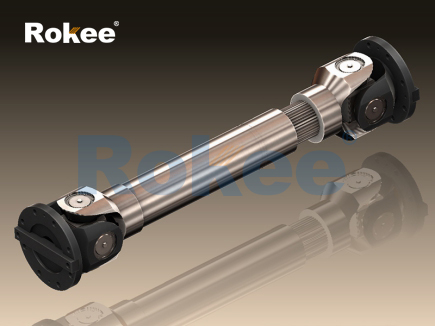
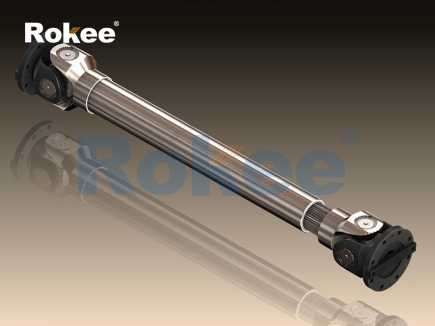
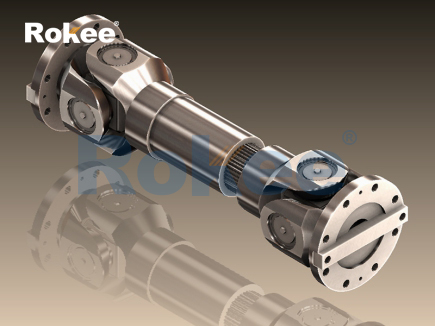
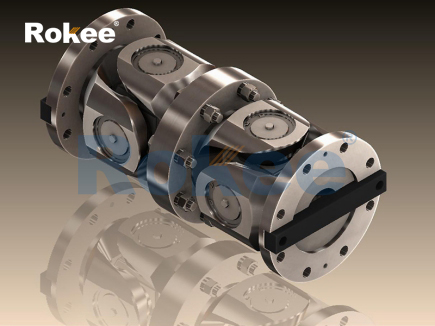
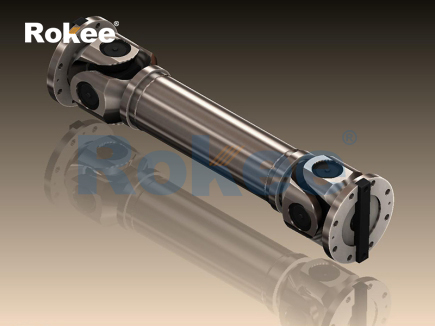
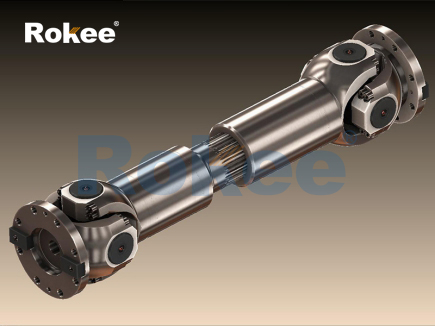
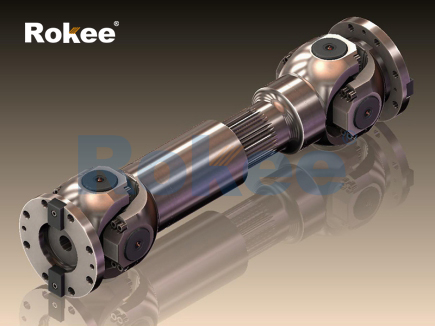
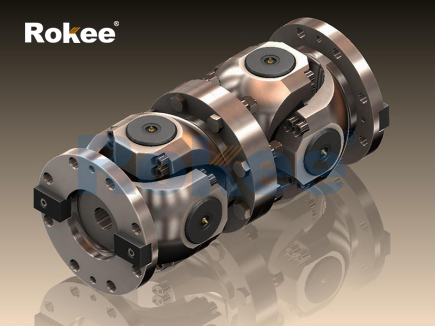
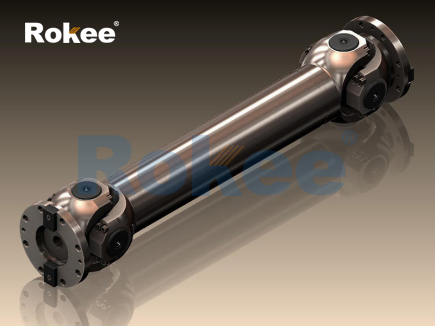
Universal shaft coupling is a fundamental mechanical component designed to transmit rotational torque between two misaligned shafts in various mechanical transmission systems. Featuring a flexible hinged structure mainly composed of cross-shaped shaft and joint forks, this mechanical part effectively accommodates angular, radial and axial deviations between connected shafts, which solves the transmission limitations of rigid coupling structures that cannot adapt to shaft position offsets. A single universal coupling can bear a certain shaft angle during operation, while the combined structure with two connected joints further optimizes transmission stability and eliminates periodic speed fluctuation of single-joint operation. With no vulnerable elastic components inside, it maintains stable working performance under harsh working conditions including high temperature, greasy dirt and mechanical vibration, achieving high transmission efficiency with minimal power loss. The structural rigidity enables it to withstand heavy torque and intermittent impact loads, avoiding component deformation and energy loss in the power transmission process. Widely applied in mechanical manufacturing, transportation equipment and industrial transmission devices, it suits complex working scenarios where shaft position changes frequently and installation alignment errors are inevitable. During continuous operation, it relieves concentrated mechanical stress on shafts and bearings, reduces component wear and extends the overall service life of transmission systems. Its simple and compact structure also facilitates easy assembly and daily maintenance, making it a reliable and versatile connecting part for general industrial mechanical transmission to balance practicality and operational stability.
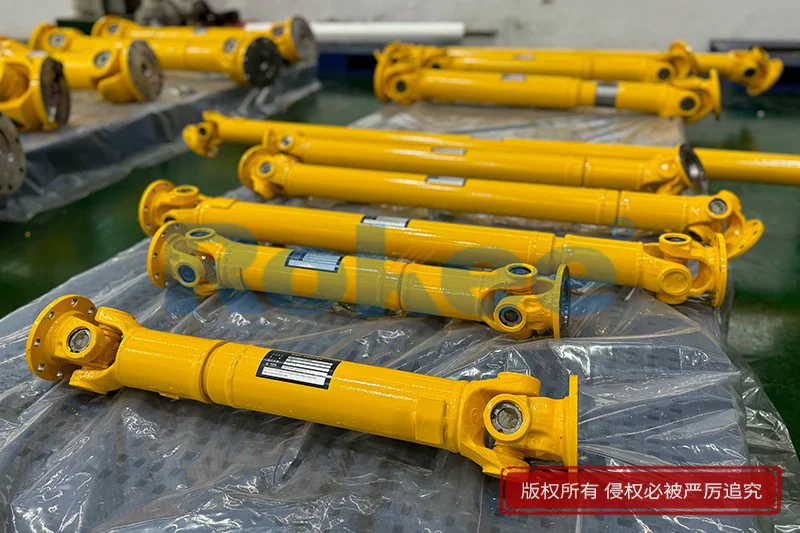
In the complex ecosystem of mechanical power transmission, few components are as indispensable yet underappreciated as the universal shaft coupling. This mechanical device, often referred to simply as a universal joint or U-joint, serves as a critical bridge between rotating shafts that are not aligned on the same axis, enabling the seamless transfer of torque and rotational motion even when angular deviations, axial displacements, or radial offsets exist. Unlike rigid couplings that demand precise alignment and offer no flexibility, universal shaft couplings are engineered to accommodate misalignments while maintaining structural integrity and transmission efficiency. Their versatility has made them a cornerstone in countless industrial, automotive, aerospace, and marine applications, spanning from heavy-duty metallurgical mills to precision robotic arms. To fully grasp the significance of this component, it is essential to explore its structural composition, working principles, design variations, material selections, application landscapes, performance characteristics, maintenance requirements, and future developmental trends.
At its core, the universal shaft coupling is defined by a relatively simple yet ingenious structural design that balances strength, flexibility, and reliability. The most fundamental iteration, known as the cross-shaft universal coupling, consists of three primary components: two yokes (also called fork-shaped joints), a cross shaft (or spider), and bearing assemblies. The yokes are mechanical connectors that attach to the driving and driven shafts, respectively, each featuring a cylindrical bore designed to fit the shaft ends and secure them through methods such as keyway connections, splines, or flange attachments. The cross shaft, as the central transmission element, resembles a four-armed cross, with each arm (or trunnion) equipped with a bearing to facilitate smooth rotation and reduce friction between the cross shaft and the yokes. These bearings—typically needle roller bearings or sliding bearings—are crucial for minimizing wear and ensuring the coupling can withstand radial and axial loads during operation. Complementing these core components are sealing and lubrication systems, which include oil seals, grease fittings, and protective covers to prevent contamination and maintain proper lubrication of the moving parts.
While the cross-shaft design forms the basis of most universal couplings, modern engineering has led to the development of specialized variants tailored to specific application requirements. One such variant is the constant velocity (CV) universal coupling, most commonly represented by the ball cage design. This type eliminates the speed fluctuations inherent in single cross-shaft couplings by incorporating a spherical outer race, a star-shaped inner race, a set of evenly spaced steel balls, and a cage that retains the balls in the bisecting plane of the angle between the two shafts. The ball cage design ensures that torque is transmitted uniformly through the steel balls, resulting in constant angular velocity between the input and output shafts, even at large angular deviations. Another variant is the double universal coupling, which consists of two single cross-shaft couplings connected by an intermediate shaft. When properly aligned—with the intermediate shaft forming equal angles with both the driving and driven shafts and the yokes at both ends positioned in the same plane—this configuration cancels out speed fluctuations, achieving smooth, constant-speed transmission. Additional variants include ball-and-socket universal couplings, which use a spherical contact surface for multi-angle articulation, and elastic universal couplings that integrate polymer or rubber components to dampen vibration and absorb shock loads.
The working principle of the universal shaft coupling is rooted in the rotational and oscillatory movement of its components, which enables torque transfer across misaligned axes. For a single cross-shaft coupling, when the driving shaft rotates, it imparts rotational motion to the attached yoke, which in turn drives the cross shaft. As the cross shaft rotates, it oscillates within the second yoke, transferring the rotational force to the driven shaft. This oscillation allows the coupling to accommodate angular misalignment between the two shafts, as the cross shaft can pivot freely in two perpendicular planes. However, this oscillatory motion introduces a key limitation: the output shaft speed is not constant when there is an angle between the shafts. Instead, the output speed fluctuates periodically, with the degree of fluctuation increasing as the angular deviation between the shafts grows. This speed variation can cause vibration, noise, and additional stress on the transmission system, which is why single cross-shaft couplings are rarely used in high-speed or precision applications without compensation.
The double universal coupling addresses the speed fluctuation issue through strategic configuration. By introducing an intermediate shaft between two single couplings, the phase shift caused by the first coupling is reversed by the second, resulting in a net constant speed at the output. To achieve this, two critical conditions must be met: the angle between the driving shaft and the intermediate shaft must be equal to the angle between the intermediate shaft and the driven shaft, and the yokes at both ends of the intermediate shaft must be aligned in the same plane. When these conditions are satisfied, the oscillatory motion of the first cross shaft is counterbalanced by the second, eliminating speed variations and ensuring smooth torque transfer. The ball cage CV coupling operates on a different principle, leveraging the geometric arrangement of the steel balls and races to maintain constant velocity. The cage ensures that each steel ball remains in the plane that bisects the angle between the input and output shafts, so the torque is transmitted through the balls at a consistent radius, resulting in uniform rotation regardless of angular misalignment.
Material selection is a critical factor in determining the performance, durability, and application range of universal shaft couplings. The choice of materials depends on various factors, including the required torque capacity, operating speed, environmental conditions (such as temperature, humidity, and corrosion exposure), and weight constraints. For heavy-duty applications that demand high strength and resistance to fatigue and impact, alloy steels are the preferred choice. Common alloy steels used include 42CrMo, 35CrMo, and 20CrMnTi, which undergo heat treatment processes such as quenching and tempering, carburizing, or induction hardening to enhance their mechanical properties. These treatments increase the material’s hardness, tensile strength, and wear resistance, making them suitable for use in metallurgical machinery, mining equipment, and industrial gearboxes.
For medium-duty applications or those with cost constraints, carbon steels such as 45# steel are commonly used. While carbon steels offer lower strength than alloy steels, they are more affordable and easier to machine, making them ideal for general industrial equipment, agricultural machinery, and light automotive applications. In corrosive environments, such as marine, chemical, or food processing industries, stainless steel (e.g., 304 or 316) or corrosion-resistant coatings (such as nickel plating or galvanization) are employed to prevent rust and degradation. For applications requiring lightweight designs, such as aerospace or robotics, aluminum alloys or titanium alloys may be used, though these materials typically have lower torque capacities and require careful design optimization to maintain structural integrity.
The bearing assemblies and auxiliary components of universal shaft couplings also rely on specialized materials to ensure performance. Needle roller bearings, which are commonly used in cross-shaft couplings, are typically made from high-carbon bearing steel or alloy steel, which is heat-treated to achieve high hardness and wear resistance. Sliding bearings, used in some low-speed or maintenance-free applications, may be constructed from bronze alloys or self-lubricating composite materials that reduce the need for frequent lubrication. Sealing components, such as oil seals and dust covers, are often made from rubber, polyurethane, or metal, depending on the operating temperature and environmental conditions. Rubber seals are suitable for moderate temperatures and general applications, while metal seals are used in high-temperature or high-pressure environments to prevent lubricant leakage and contamination.
The manufacturing processes employed in producing universal shaft couplings play a vital role in ensuring precision, consistency, and structural integrity. The cross shaft and yokes are typically manufactured using forging processes, such as open die forging or closed die forging, which compress the metal to eliminate internal defects, improve grain structure, and enhance mechanical strength. Forging is particularly important for heavy-duty components, as it creates a denser material structure that can withstand higher torque and impact loads. After forging, the components undergo machining processes, including turning, milling, drilling, and grinding, to achieve the required dimensional accuracy and surface finish. Precision machining is critical to ensuring proper fit between the cross shaft, bearings, and yokes, as any deviation can lead to increased friction, vibration, and premature wear.
Heat treatment is another essential manufacturing step, as it modifies the material’s mechanical properties to meet application requirements. Quenching and tempering are commonly used to improve the strength and toughness of steel components, while carburizing is employed to harden the surface of the cross shaft trunnions and yoke bores, enhancing wear resistance. Induction hardening is often used for localized hardening of specific components, such as the cross shaft arms, to balance hardness and ductility. For high-speed applications, dynamic balancing is a critical process that involves removing material from the coupling components to eliminate centrifugal imbalance. Imbalanced couplings can cause excessive vibration, noise, and stress on the transmission system, reducing overall reliability and service life. Dynamic balancing is typically performed using specialized equipment that measures the imbalance and identifies the areas where material should be removed.
The versatility of universal shaft couplings is reflected in their wide range of applications across diverse industries. In heavy industry, they are indispensable components in metallurgical mills, where they connect the motor to the rolling stands, accommodating the angular misalignments caused by thermal expansion and mechanical deflection. Mining equipment, such as crushers, conveyors, and excavators, relies on universal couplings to transmit high torque in harsh conditions, where dust, vibration, and misalignment are common. In these applications, the couplings must withstand extreme loads and frequent impact, making alloy steel constructions with robust sealing systems essential.
The automotive industry is another major user of universal shaft couplings, particularly in the drivetrains of rear-wheel-drive, four-wheel-drive, and all-wheel-drive vehicles. In these systems, universal couplings connect the transmission to the drive shaft and the drive shaft to the differential, allowing for angular misalignment as the suspension moves and the vehicle turns. Ball cage CV couplings are commonly used in front-wheel-drive vehicles, as they provide constant-speed transmission and can accommodate large angular deviations, ensuring smooth performance during steering. Heavy-duty vehicles, such as trucks and buses, use double universal couplings to transmit high torque while maintaining stability, even under varying load conditions.
In the energy sector, universal shaft couplings are used in wind turbines, where they connect the rotor to the gearbox and the gearbox to the generator. These couplings must accommodate the misalignments caused by wind-induced vibration and thermal expansion, while transmitting high torque efficiently. They are also used in pumps, compressors, and turbines in power plants, where reliability and efficiency are critical. Precision machinery, such as CNC machine tool, robotic arms, and automated production lines, relies on high-precision universal couplings to ensure accurate torque transfer and positional control. Ball cage CV couplings are preferred in these applications, as they minimize speed fluctuations and vibration, ensuring precise operation.
Marine and aerospace applications also benefit from the versatility of universal shaft couplings. In ships, they are used in propulsion systems to connect the engine to the propeller shaft, accommodating the misalignments caused by hull deformation and thermal expansion. Marine couplings must be corrosion-resistant and able to withstand saltwater exposure, making stainless steel or specialized coatings essential. In aerospace, lightweight universal couplings are used in aircraft engines, control systems, and landing gear mechanisms, where weight reduction and reliability are paramount. These couplings are typically made from titanium alloys or high-strength aluminum, with precision machining and dynamic balancing to meet strict performance standards.
Like any mechanical component, universal shaft couplings have inherent advantages and limitations that influence their suitability for specific applications. One of their primary advantages is their exceptional ability to compensate for multiple types of misalignment, including angular, axial, and radial deviations. This flexibility reduces the need for precise installation and alignment, simplifying the assembly process and accommodating dynamic changes in the transmission system, such as those caused by thermal expansion, vibration, or mechanical deflection. Universal couplings also offer high torque transmission capacity relative to their size, making them compact and efficient in space-constrained applications.
Another key advantage is their high transmission efficiency, which typically ranges from 98% to 99.8% for well-maintained couplings. This high efficiency minimizes energy loss, making them suitable for high-power applications where energy conservation is important. Many universal coupling designs also feature modular construction, which simplifies maintenance and repair by allowing easy replacement of worn components, such as bearings or seals, without replacing the entire coupling. Additionally, they can absorb minor vibrations and shocks, reducing stress on other components in the transmission system and improving overall system reliability.
Despite their numerous advantages, universal shaft couplings have several limitations that must be considered during selection and application. As previously noted, single cross-shaft couplings produce periodic speed fluctuations when misaligned, which can cause vibration, noise, and increased wear on the transmission system. This limitation restricts their use in high-speed or precision applications unless paired with a second coupling to form a double universal configuration. Universal couplings also require regular maintenance, particularly lubrication, to ensure smooth operation and prevent premature wear. The sliding and rolling contact between the cross shaft and bearings generates friction, which can lead to wear if not properly lubricated. In harsh environments, seals may degrade over time, allowing contamination and lubricant leakage, which further accelerates wear.
Manufacturing and installation requirements for universal couplings are also relatively strict. Precision machining is necessary to ensure proper fit and alignment of components, which can increase production costs. During installation, improper alignment—even within small tolerances—can exacerbate wear, reduce efficiency, and shorten service life. High-speed applications require rigorous dynamic balancing, which adds to the overall cost and complexity. Additionally, universal couplings have limited misalignment capacity; exceeding the recommended angular or axial deviation can lead to catastrophic failure, making proper sizing and selection critical.
Proper maintenance and care are essential to maximizing the service life and performance of universal shaft couplings. A comprehensive maintenance program should include regular inspection, lubrication, alignment checks, and component replacement as needed. Inspection should be performed at regular intervals to assess the condition of the coupling components, including the cross shaft, bearings, yokes, seals, and fasteners. Signs of wear, such as excessive play, corrosion, cracks, or lubricant contamination, should be addressed immediately to prevent further damage. Vibration and noise analysis can also be used to detect early signs of failure, such as imbalanced components or worn bearings.
Lubrication is perhaps the most critical maintenance task for universal couplings. The type of lubricant used should be selected based on the operating temperature, speed, and load conditions. Lithium-based greases are commonly used for general applications, as they offer good lubricity and stability over a wide temperature range. For high-temperature applications, such as those in metallurgical or industrial ovens, synthetic greases or oil-based lubricants may be required to prevent degradation. Lubrication intervals depend on the application and operating conditions, but typically range from 500 to 2,000 operating hours. When lubricating, it is important to fill the coupling with the correct amount of lubricant—usually one-third to one-half of the cavity volume—to ensure adequate coverage without causing excessive pressure.
Alignment checks are another important maintenance activity. Over time, vibrations, thermal expansion, and mechanical stress can cause misalignment between the driving and driven shafts, which increases wear on the coupling and other transmission components. Laser alignment tools are recommended for precise alignment, as they can detect small deviations and ensure the shafts are aligned within the recommended tolerances. For double universal couplings, it is essential to verify that the intermediate shaft angles and yoke alignment meet the required conditions to maintain constant-speed transmission.
Seal maintenance is also critical to preventing contamination and lubricant leakage. Seals should be inspected regularly for signs of damage, such as cracks, hardening, or deformation, and replaced if necessary. In harsh environments, upgrading to more robust sealing systems, such as labyrinth seals or double lip skeleton oil seal, can improve contamination resistance and extend the life of the coupling. Fasteners, such as bolts and nuts, should be checked for tightness at regular intervals, as vibration can cause them to loosen over time. Loose fasteners can lead to misalignment, increased vibration, and component failure.
The future of universal shaft couplings is shaped by ongoing advancements in materials science, manufacturing technology, and industrial automation. One key trend is the development of high-performance materials that offer improved strength, durability, and corrosion resistance while reducing weight. Advanced alloys, composite materials, and surface treatments are being explored to enhance the performance of couplings in extreme environments, such as high temperatures, high pressures, and corrosive conditions. For example, carbon fiber composites are being tested for lightweight applications, offering high strength-to-weight ratios that can reduce energy consumption and improve overall system efficiency.
Another trend is the integration of smart technologies into universal couplings to enable condition monitoring and predictive maintenance. Embedded sensors, such as temperature sensors, vibration sensors, and wear sensors, can collect real-time data on the coupling’s performance, allowing operators to detect early signs of failure and schedule maintenance before catastrophic damage occurs. This data can be transmitted to a central monitoring system, where it is analyzed using machine learning algorithms to predict maintenance needs and optimize performance. Smart couplings can also provide insights into operating conditions, such as load distribution and misalignment, enabling operators to adjust the system for maximum efficiency.
Advancements in manufacturing technology, such as additive manufacturing (3D printing), are also transforming the production of universal shaft couplings. Additive manufacturing allows for the creation of complex geometries that are difficult or impossible to produce using traditional machining methods, enabling the design of couplings with improved performance characteristics, such as enhanced load distribution and reduced weight. This technology also allows for rapid prototyping and customization, making it easier to develop couplings tailored to specific application requirements. Additionally, additive manufacturing can reduce material waste and production time, lowering overall costs.
The demand for more efficient and environmentally friendly transmission systems is also driving innovation in universal coupling design. Manufacturers are developing couplings with higher transmission efficiency, lower energy loss, and reduced noise and vibration to meet increasingly strict environmental regulations. For example, optimized bearing designs and lubrication systems are being used to minimize friction and energy consumption. Additionally, the development of maintenance-free couplings, which use self-lubricating materials or sealed designs, is reducing the environmental impact of lubricant use and disposal.
In conclusion, the universal shaft coupling is a versatile and critical component in mechanical power transmission systems, enabling the reliable transfer of torque across misaligned axes in a wide range of applications. Its simple yet effective design, combined with advancements in materials, manufacturing, and technology, has made it an indispensable part of modern industry. From heavy-duty metallurgical mills to precision robotic arms, universal couplings play a vital role in ensuring the efficiency, reliability, and performance of transmission systems. While they have inherent limitations, proper selection, installation, and maintenance can maximize their service life and minimize downtime.
As industries continue to evolve and demand higher performance, efficiency, and reliability, the universal shaft coupling will continue to adapt and improve. Advancements in smart technology, materials science, and manufacturing will drive the development of more durable, efficient, and versatile couplings that can meet the challenges of emerging applications. Whether in traditional industrial settings or cutting-edge aerospace and renewable energy systems, the universal shaft coupling will remain a cornerstone of mechanical power transmission for years to come.
The ongoing refinement of universal coupling designs will also focus on addressing existing limitations, such as speed fluctuations and maintenance requirements. New configurations and materials will likely emerge to reduce vibration, extend service life, and eliminate the need for frequent lubrication. As the global push for sustainability and efficiency intensifies, universal couplings will play an increasingly important role in optimizing energy use and reducing environmental impact across industries. By combining time-tested principles with innovative technologies, the universal shaft coupling will continue to be a vital link in the chain of mechanical power transmission, supporting the growth and advancement of modern engineering.
pu sandwich panel line,pu sandwich panel machine,sandwich panel machine
« Universal Shaft Couplings » Latest Update Date: May 9, 2026
https://www.rokeecoupling.net/tags/universal-shaft-couplings.html