Internal Spline Drum Coupling
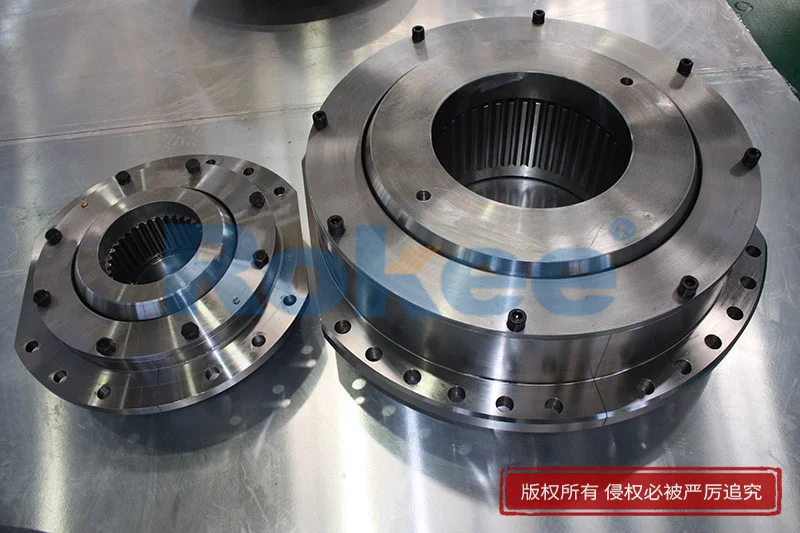
Internal Spline Drum Coupling, heavy-duty spline drum coupling for lifting machinery. Compact structure, reliable transmission, wear-resistant. OEM & custom machining supported for your hoist system. Rokee is a internal spline drum coupling supplier in China. We support custom orders and offer direct factory sales, providing reliable products with flexible solutions for global clients.
This internal spline drum coupling is a heavy-duty flexible transmission part connecting rotating shafts to transfer torque while tolerating limited shaft misalignment. It mainly consists of an inner spline hub, drum-shaped gear sleeve, seals and fasteners made of alloy steel and elastic sealing materials. Torque is transmitted via multi-tooth meshing of curved drum teeth with lubrication between contact surfaces. Featuring compact size, strong load capacity and stable torsional rigidity, it serves bulk handling, metallurgy, mining and port machinery. Proper alignment, lubrication and routine inspection are required for reliable operation.
-
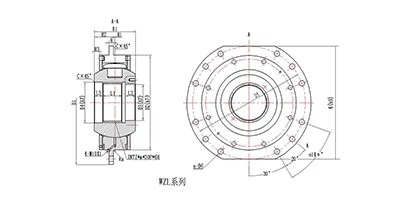
WZL Drum Coupling
ball-joint
WZL spherical hinged drum coupling connects reducer and hoisting drum. It adopts spherical hinge structure with spline sleeve, capable of transferring large torque and radial load, compensating angular displacement up to 3°, widely used for crane hoisting mechanisms. -
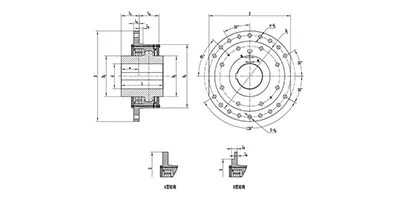
DC Drum Coupling
Gear Type
DC hoisting drum coupling with crowned tooth design connects reducer and drum in hoisting drive systems. It supports radial load and high torque transmission, with no capacity for axial load transfer. -
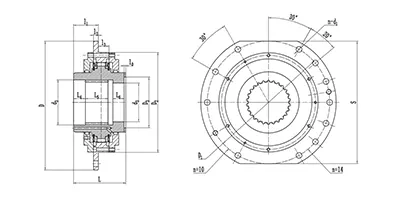
WJ Drum Coupling
spherical roller
WJ hoisting drum coupling is a spherical roller coupling composed of outer sleeve with connecting flange, spherical rollers, half coupling, inner & outer cover plates and sealing system. It delivers high torque and withstands radial loads. -
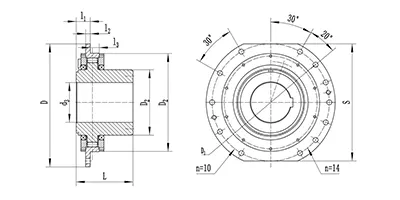
WJA Drum Coupling
involute spline pair
WJA hoisting drum coupling is a spherical roller coupling composed of outer sleeve with connecting flange, spherical rollers, half coupling, inner & outer cover plates and sealing system. It delivers high torque and withstands radial loads. An involute spline pair is adopted for the connection between the coupling and the reducer output shaft. -
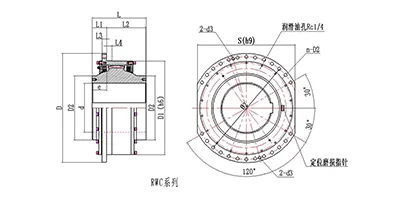
RWC Drum Coupling
Spherical Crowned Tooth
RWC Spherical Crowned Tooth Drum Coupling, developed by Rokee, features a more robust structure, superior misalignment compensation and higher safety factor. Its outer hub adopts spherical crowned tooth design, requiring lower alignment precision for shafting, with large transmission torque and strong overload capacity, and can withstand heavy radial loads. It shares the same mounting dimensions as the DC series while boasting over 30% higher load capacity. The innovative spherical sealing technology ensures excellent lubrication retention and greatly extended service life.
The internal spline drum coupling is a type of flexible transmission component designed to connect two rotating shafts and transmit torque while accommodating misalignment between connected equipment. It integrates spline engagement and drum-shaped tooth meshing structures, delivering reliable power transfer under relatively heavy load conditions. Unlike ordinary rigid couplings, it can buffer part of the impact and vibration generated during operation, making it widely adopted in heavy-duty rotating systems that require compact installation space and stable torque transmission. This coupling balances transmission rigidity and certain flexible compensation capacity, serving as a critical link between driving and driven parts in mechanical transmission chains.
Structural Composition and Materials
The main assembly of an internal spline drum coupling consists of an inner spline hub, a drum-shaped outer gear sleeve, sealing assemblies, and fasteners. The inner spline hub features precision-machined internal spline grooves, which mate with the curved tooth profile on the outer surface of the drum sleeve. The drum-shaped teeth adopt a special curved outline, which is the core structure for realizing misalignment compensation. Sealing components are arranged at the joint gaps to block external dust, debris and moisture and retain internal lubricant. Fasteners lock components to prevent relative circumferential sliding and axial separation during rotation.
Common structural materials are selected based on load magnitude and operating environment. The main load-bearing parts including the spline hub and drum gear sleeve generally use medium carbon alloy steel with good hardenability. After machining, these parts undergo surface heat treatment to improve surface hardness, wear resistance and contact fatigue strength. Sealing elements are usually made of elastic polymer materials with stable aging resistance. Auxiliary fasteners adopt high-strength alloy steel to maintain clamping reliability under cyclic loads.
Working Principle
Torque transmission relies on the meshing contact between the internal spline and drum-shaped outer teeth. When the driving shaft rotates, the inner spline hub drives the drum gear sleeve through tooth contact, and the drum sleeve further transfers torque to the driven shaft. The curved drum tooth profile allows limited relative displacement between meshing teeth. When radial, angular or slight axial misalignment exists between the two connected shafts, the drum teeth can slide appropriately along the tooth surface without generating excessive additional bending stress on the shafts.
A thin layer of lubricating medium is kept between the contact surfaces of splines and drum teeth. The lubricant reduces friction coefficient during relative sliding, avoids dry friction and adhesive wear. Under cyclic torque, load is distributed on multiple pairs of meshing teeth, instead of concentrating on a single tooth, which helps to stabilize contact pressure and extend service life of the meshing pair.
Features and Advantages
This coupling provides relatively large torque transmission capacity within a compact radial dimension. The drum tooth profile enables simultaneous compensation for angular, radial and minor axial misalignment, lowering assembly difficulty and reducing additional load imposed on bearings of connected equipment. Multi-tooth meshing disperses contact stress, so it can withstand periodic impact loads to a certain extent.
Its integrated spline and drum tooth layout simplifies the overall transmission arrangement and reduces the required axial installation space compared with some separated flexible couplings. The enclosed lubrication and sealing structure reduces daily lubrication frequency and protects the meshing pair from abrasive contaminants. The contact mode maintains stable torsional rigidity under normal working conditions, which avoids excessive torsional deformation that may affect transmission accuracy. In addition, the structure is convenient for disassembly and inspection without needing to move the connected equipment over a long axial distance.
Applicable Working Conditions and Application Industries
It is suitable for transmission systems with medium to heavy torque, continuous rotation and occasional load fluctuation. It works well in scenarios where shaft misalignment cannot be completely eliminated due to manufacturing tolerance, foundation settlement or thermal expansion of equipment. Continuous low-to-medium speed operation is the primary applicable condition; it is not recommended for long-term operation under extreme rotating speed that causes severe centrifugal effect.
Typical application fields include bulk material handling machinery, metallurgical auxiliary transmission equipment, port loading and unloading machinery, mining transport devices, and large pumping units. It is also used in heavy-duty conveying equipment and rotary driving mechanisms where compact layout and high load capacity are required. It fits equipment that runs stably for long hours and needs dependable torque transfer with limited maintenance downtime.
Key Points for Installation and Commissioning
Before installation, all matching surfaces, spline grooves and drum tooth surfaces must be cleaned thoroughly to remove machining chips, rust and residual foreign matter. Lubricant with proper performance shall be evenly applied to the meshing surfaces. The alignment of two connected shafts needs to be adjusted to keep misalignment within the allowable range of the coupling; excessive misalignment will accelerate tooth surface wear and shorten service life.
After positioning each component, fasteners shall be tightened following a symmetrical sequence to ensure uniform preload. Seals should be checked to guarantee full contact without distortion or extrusion damage. After assembly, manual rotation of the whole transmission system is required to confirm no jamming or abnormal resistance. During initial commissioning, the equipment shall run under no-load or light load for a period of time first. Operators need to observe running noise, temperature rise and sealing status, and stop operation promptly if abnormal sound or lubricant leakage appears for recheck and adjustment.
Selection and Customization
The core basis for selection includes rated transmission torque, actual working load characteristics, rotating speed, allowable installation space and ambient conditions. The peak torque generated during startup, braking and impact should be considered instead of only referring to steady-state operating torque. The overall dimension is confirmed according to the shaft diameters of driving and driven ends and reserved installation space.
Customization can be carried out for special working demands. Modification items cover spline parameters, tooth width of drum teeth, structural form of sealing parts, and surface treatment processes for anti-corrosion requirements. When the coupling operates in high-humidity, dusty or corrosive surroundings, targeted adjustments on sealing structure and material matching can be provided. Customized designs need to match the load cycle and misalignment demand of the specific transmission system to avoid insufficient compensation capacity or premature wear.
Operation and Maintenance
Regular visual inspection is the basic maintenance measure. Check whether there is lubricant leakage at sealing positions, whether abnormal noise or obvious vibration occurs during running, and whether the surface temperature of the coupling assembly keeps within a normal range. Periodic lubricant replacement should follow the actual working duration and environmental pollution degree. Old deteriorated lubricant must be completely drained, and the inner cavity cleaned before injecting new lubricant.
During shutdown maintenance, the meshing condition of splines and drum teeth can be inspected. Attention should be paid to tooth surface wear, pitting and scratch marks. If serious tooth surface damage, excessive backlash or permanent deformation is found, relevant components should be replaced in time. Avoid long-term overload operation, which will cause accelerated fatigue damage of the meshing pair. Record maintenance time, lubrication status and abnormal phenomena to form a continuous operation reference for the transmission component. Regularly recheck the tightness of fasteners, as cyclic vibration may lead to loosening and cause abnormal load distribution.