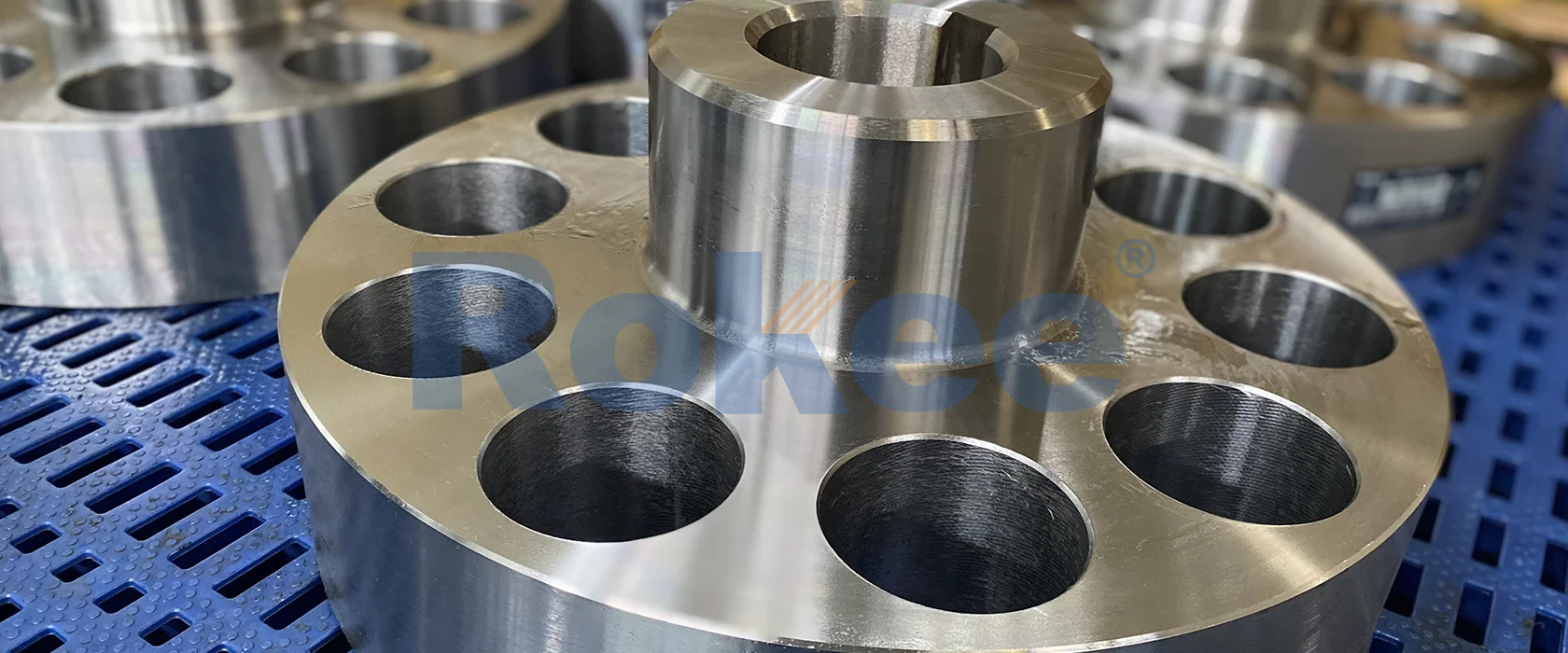
Rokee is a well-known high-quality supplier of Bush Type Couplings and technical services in China, customize bush type couplings according to user drawings, alternatively, if the user provides bush type couplings parameters, we can select the model and design drawings for you, support wholesale and export.
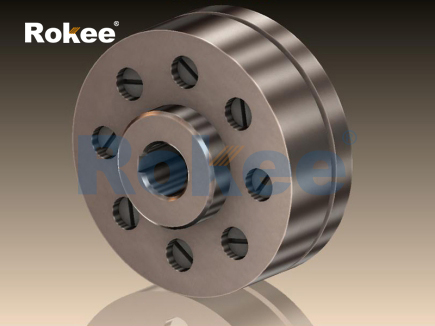
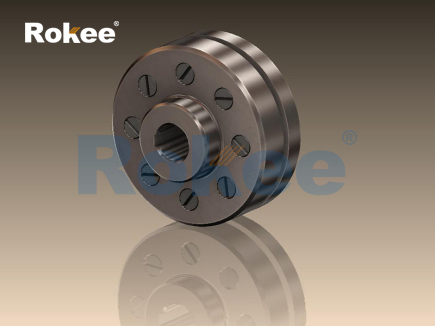

Bush Type Coupling is a flexible connection device widely used in modern industrial machinery transmission systems. It transmits torque and compensates for various deviations by inserting elastic sleeves between two shaft ends. This type of coupling has been widely used in the industrial field due to its unique structural design, especially in situations where it is necessary to absorb vibration, reduce impact, and compensate for shaft alignment errors.
Compared with traditional rigid couplings, the most significant feature of Bush Type Couplings is the use of high elastic materials as intermediate connecting media. This design not only effectively transmits power, but also absorbs and buffers additional stress caused by shaft misalignment, vibration, or impact loads, protecting key components in the transmission system from damage.
The Bush Type Coupling mainly consists of three key components:
Wheel hub assembly: usually made of high-strength metal (such as steel or cast iron), including two wheel hubs installed on the driving shaft and the driven shaft respectively
Elastic bushing: a flexible component made of rubber, polyurethane, or other polymer materials, which is the core functional component of a coupling
Connectors: including bolts, pins, or other fastening devices used to securely connect the hub to the liner
The working principle of the Bush Type Coupling is based on a composite mechanism of elastic deformation and frictional transmission:
When the drive shaft rotates, torque is first transmitted to the wheel hub connected to it
Through the connecting piece, torque is transmitted to the elastic lining
The liner undergoes controllable elastic deformation when subjected to torque
The deformed liner transfers torque to another hub, ultimately driving the driven shaft to rotate
During this process, the deformation ability of the elastic lining enables the coupling to compensate for axial, radial, and angular deviations, while absorbing vibration energy and reducing impact transmission.
Excellent vibration damping performance: The elastic lining can effectively absorb and dampen vibrations, reducing transmission system noise
Good deviation compensation capability: can simultaneously compensate for axial, radial, and angular deviations, with typical compensation values up to:
Axial deviation: ± 0.5-5mm
Radial deviation: 0.5-3mm
Angular deviation: 1 ° -3 °
Overload protection function: Under abnormal working conditions, the lining can be damaged first, protecting more valuable equipment components
Maintenance free design: Most Bush Type Couplings do not require lubrication, reducing maintenance costs
Easy installation: usually does not require special tools, and the shaft alignment requirements are relatively loose
Limited torque transmission: Compared to metal couplings, the transmission capacity is limited by the strength of the lining material
Temperature sensitivity: The performance of elastic materials is greatly affected by temperature, and the working temperature range is usually from -40 ℃ to+100 ℃
Aging issue: Rubber and other materials will age over time and require regular inspection and replacement
Low torsional stiffness: not suitable for situations requiring high transmission accuracy
Sleeve type bushing coupling:
The simplest and most economical design
A single elastic sleeve is fitted onto both ends of the shaft
Suitable for light load and low-speed applications
Flange type bushing coupling:
Connected through flange
The liner is placed between the flanges
Capable of transmitting large torque
Claw type bushing coupling:
Equipped with interlocking claws
The liner is filled in the gap between the protruding claws
Provide better torque transmission and deviation compensation
Rubber lined coupling:
Natural or synthetic rubber
Excellent vibration damping performance
lower cost
Polyurethane lined coupling:
Higher strength and wear resistance
Good oil resistance performance
Long lifespan
Composite material sleeve coupling:
Composite of multiple materials
Customizable performance
Special working condition application
Torque requirements: including rated torque and peak torque
Shaft diameter size: determines the specification of the coupling interface
Deviation situation: Estimated system alignment deviation amount
Speed range: maximum operating speed
Environmental conditions: temperature, humidity, corrosiveness, etc
Space limitations: Install space size constraints
Industrial pump system
In fluid machinery such as centrifugal pumps and plunger pumps, Bush Type Couplings can effectively isolate motor vibration, compensate for deviations caused by thermal expansion of the pump body, and extend the service life of mechanical seals. Especially in chemical process pumps, their corrosion resistance is particularly important.
Fan and compressor
Large industrial fans often use Bush Type Couplings to absorb vibrations caused by impeller imbalance and reduce bearing loads. In screw compressors, it can compensate for rotor thermal deformation and ensure long-term stable operation.
Material conveying equipment
Lined couplings are widely used in continuous transportation equipment such as belt conveyors and chain conveyors. Their buffering characteristics can reduce starting impact and protect key components such as reducers.
power generation equipment
In diesel generator sets, Bush Type Couplings are used to connect the engine and generator, effectively damping the periodic torsional vibration of the internal combustion engine and improving the quality of power supply.
As an economical and practical flexible connection device, the Bush Type Coupling plays an irreplaceable role in modern industrial transmission systems. With the advancement of materials science and manufacturing technology, its performance and application scope are still constantly expanding. Proper selection, installation, and maintenance of Bush Type Couplings can significantly improve the reliability and service life of mechanical systems, and reduce overall operating costs.
« Bush Type Couplings » Post Date: 2024/4/23 , https://www.rokeecoupling.net/tags/bush-type-couplings.html