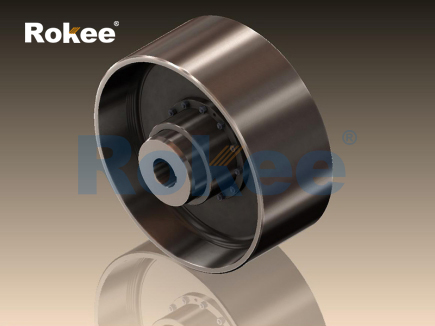
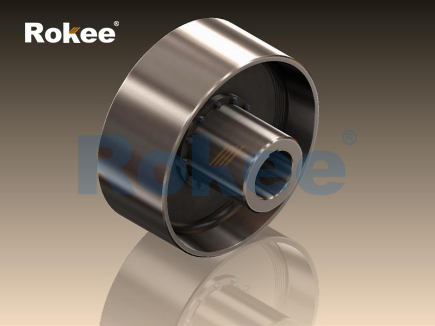
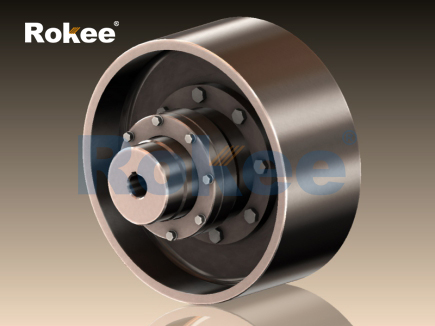
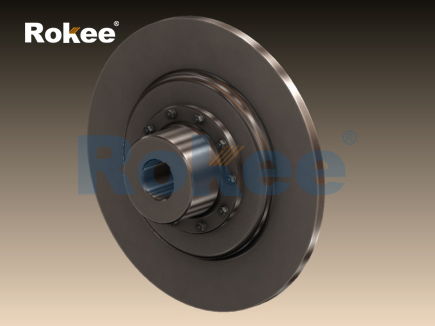
Brake drum gear coupling stands as a vital mechanical transmission component widely applied in heavy-duty industrial transmission systems, which integrates the gear transmission structure and brake drum functional design into a single integrated mechanical unit. Unlike ordinary gear couplings that only undertake torque transmission tasks, this type of coupling ingeniously combines power transmission, axis deviation compensation and mechanical braking functions, effectively simplifying the overall structural layout of mechanical equipment and optimizing the operational stability of shaft transmission systems. In modern industrial production scenarios characterized by heavy load, frequent start-stop motion and strict braking requirements, brake drum gear coupling has become an indispensable connecting part for rotating shafts due to its outstanding mechanical adaptability and durable structural characteristics. Its unique composite design breaks the functional limitation of single transmission components, realizing the organic integration of power delivery and motion control, and providing reliable technical support for the safe and efficient operation of various heavy machinery.
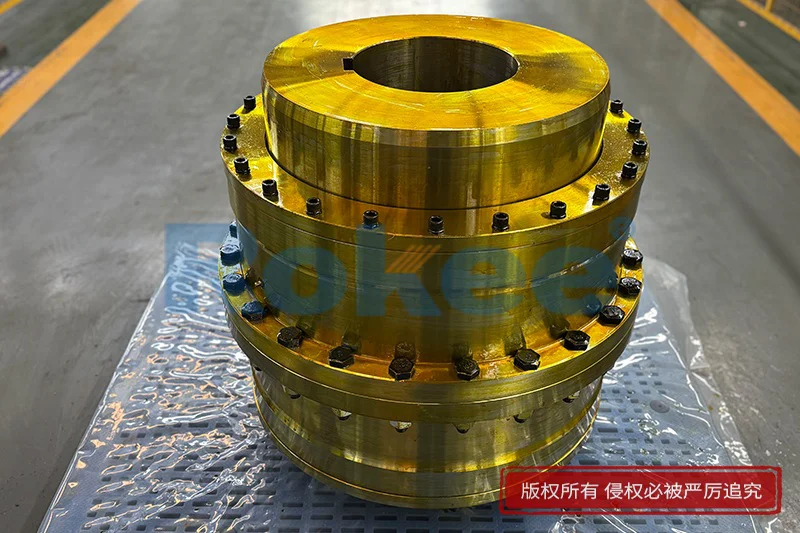
The internal structure of brake drum gear coupling adopts a compact and reasonable combined layout, mainly composed of an inner gear ring, outer gear half-coupling, integrated sealing assembly and integral brake drum. The outer gear part adopts a spherical crown tooth design, with the spherical center coinciding with the central axis of the gear, which fundamentally optimizes the meshing state between gear teeth compared with traditional straight-tooth gear structures. The tooth side gap of the crown tooth structure is more than fifty percent larger than that of conventional straight-tooth couplings, creating sufficient deformation space for gear meshing during equipment operation. The inner gear ring is manufactured with high-precision hobbing technology, which can achieve tight meshing fit with the outer crown teeth, and the uniform tooth surface contact effectively disperses the transmission stress generated during torque conversion. The brake drum is integrally cast with the half-coupling flange, maintaining high coaxiality with the transmission shaft during the casting and machining process, and the smooth outer circular surface of the brake drum can be perfectly matched with various external brake components to complete the braking action. In addition, the integral sealing end cover and rubber sealing ring form a closed internal protection space, which can isolate external dust, moisture and corrosive impurities, and prevent lubricating grease from overflowing during high-speed operation. Auxiliary structural parts such as retaining rings and positioning bolts are used to fix the relative positions of all components, avoiding structural loosening caused by mechanical vibration in long-term operation, and further improving the overall structural firmness of the coupling.
In terms of mechanical performance, brake drum gear coupling has prominent advantages in load bearing, displacement compensation and transmission efficiency. The optimized crown tooth meshing structure reduces stress concentration at the tooth root, effectively improving the bearing capacity by fifteen to twenty percent compared with ordinary straight-tooth gear couplings of the same volume. This excellent load-bearing performance enables it to stably bear large instantaneous torque and continuous heavy load, adapting to harsh working conditions with unstable load changes. The angular displacement compensation capacity of the coupling can reach up to one point five degrees, which can effectively compensate for axis radial deviation, axial displacement and angular inclination generated by installation errors, equipment vibration and thermal deformation of mechanical parts. The reasonable tooth gap design buffers the mechanical impact generated during equipment start-up, shutdown and load switching, reducing vibration amplitude and noise in the transmission process. The transmission efficiency of the whole coupling is as high as ninety-nine point seven percent, with extremely low mechanical energy loss during torque transmission, realizing efficient conversion and delivery of mechanical power. Meanwhile, the metal integral structure has excellent temperature resistance and wear resistance, which can maintain stable mechanical performance in high-temperature working environments generated by long-term friction and heavy load operation. The integrated brake drum structure eliminates the need for additional braking connecting parts, shortening the power transmission path and reducing the structural vibration amplitude of the braking system, so that the braking response is more sensitive and the braking effect is more stable.
According to structural differences, connection forms and functional optimization directions, brake drum gear couplings can be divided into multiple classification types to meet the differentiated needs of diverse industrial working conditions. Based on the sealing structure, it can be categorized into integral sealed type and split sealed type. The integral sealed type adopts an integrated end cover sealing structure with good overall tightness, which is suitable for harsh working environments with severe dust and strong corrosiveness, and can prolong the grease replacement cycle and reduce daily maintenance frequency. The split sealed type features a simple disassembly structure, facilitating daily inspection of internal gear wear and quick replacement of sealing accessories, and is more applicable for equipment that requires regular component maintenance. In accordance with the tooth shape design, it is divided into shallow crown tooth type and deep crown tooth type. The shallow crown tooth type has a compact structure and small rotation inertia, suitable for medium and high-speed transmission equipment with stable load; the deep crown tooth type has a larger tooth surface contact area and stronger deformation resistance, which can withstand severe impact loads and is commonly used in low-speed and heavy-duty mechanical systems. Depending on the flange connection mode, it can be classified into rigid flange connection type and flexible assembly connection type. The rigid flange connection adopts integral forging molding with high structural rigidity, which is not easy to deform under extreme load and ensures high transmission accuracy; the flexible assembly connection is equipped with buffer gaskets at the connection positions, which can further weaken vibration conduction and protect the connecting shaft and bearing components. In addition, based on the overall structural length, there are short cylinder type and intermediate sleeve type products. The short cylinder type has a compact volume and occupies a small installation space, suitable for mechanical equipment with compact internal structure; the intermediate sleeve type increases the transmission distance through the intermediate connecting sleeve, meeting the connection requirements of spaced transmission shafts.
Brake drum gear coupling has extremely wide industrial application coverage, mainly serving heavy machinery and transmission equipment that require synchronous braking and stable torque transmission. In the metallurgical industry, it is applied to rolling mills, smelting conveying equipment and metal forging machinery. These devices need to bear continuous heavy load and frequent start-stop operations, and the coupling can maintain stable meshing transmission under high-temperature and dusty working conditions, while cooperating with braking components to complete accurate parking and emergency braking of rolling rollers to ensure production safety. In the mining industry, the coupling is installed on mine hoists, crushing equipment and belt conveyors. The complex underground working environment puts forward high requirements for the dust resistance and impact resistance of transmission parts, and the sealed structure and high load-bearing performance of brake drum gear coupling can adapt to harsh conditions such as mineral particle impact and humid air, effectively reducing the failure rate of transmission shafts. In the field of port and logistics machinery, it is used for container cranes, stackers and bulk cargo handling equipment. Such large-scale handling machinery needs to realize flexible speed regulation and stable braking during operation, and the excellent displacement compensation capability of the coupling can offset the axis deviation caused by equipment shaking, avoiding component wear and transmission failure.
In the building materials and chemical industry, brake drum gear coupling is matched with rotary kilns, mixing mixers and heavy-duty stirring equipment. These devices run continuously for a long time with stable load but large operation inertia, and the efficient transmission performance and durable structural materials of the coupling can support long-term uninterrupted operation. The integrated brake drum can complete slow braking and fixed-point parking of inertial equipment, preventing equipment damage caused by inertial rotation. In the transportation and marine industry, it is applied to heavy-duty trailer transmission systems and medium-sized ship propulsion auxiliary mechanisms. The compact integrated structure saves the limited installation space of transportation equipment, and the good vibration damping effect reduces the mechanical vibration during driving, improving the running stability of vehicles and ships. Moreover, in the power industry, the coupling serves for fan equipment, water pump units and power transmission machinery in thermal power plants. It can adapt to medium-speed and stable load operating conditions, reduce the energy consumption loss in the transmission process, and realize quick stop operation of power equipment to meet the safety maintenance requirements of power production.
In actual industrial application, brake drum gear coupling also has obvious practical usage advantages and standardized maintenance principles. Its highly integrated structure simplifies the assembly process of mechanical transmission systems, reduces the number of connecting parts and assembly steps, and lowers the installation difficulty and assembly cost of equipment. The universal structural size design enables it to be compatible with most braking execution components on the market, without complicated structural modification during equipment matching, which improves the versatility of mechanical design. For daily maintenance, users only need to regularly check the tightness of sealing parts and the lubrication state of internal gear teeth, and replace lubricating grease according to the working frequency. The metal parts with wear resistance are not easy to age and damage, and the overall service life is far longer than that of elastic couplings made of polymer materials. Nevertheless, the coupling also has certain usage limitations. It relies on lubricating grease to reduce gear friction, so regular maintenance is indispensable, and it is not suitable for ultra-high-speed transmission scenarios with extremely strict heat dissipation requirements. In addition, its integral metal structure has poor vibration damping capacity for extreme impact loads, so it needs to be equipped with buffer components when used in equipment with highly frequent impact loads.
With the continuous upgrading of modern industrial manufacturing technology, the production process and structural design of brake drum gear coupling are also constantly optimized. Advanced precision forging and heat treatment technologies are adopted in raw material processing to improve the hardness and toughness of metal materials, further enhancing the wear resistance and fatigue resistance of gear teeth and brake drums. The internal lubrication channel design is optimized to make the grease circulation more uniform, reducing local high-temperature wear caused by poor lubrication. Meanwhile, lightweight structural optimization is carried out on the premise of ensuring load-bearing performance, reducing the self-weight and rotation inertia of the coupling, and improving the dynamic response speed of mechanical transmission. In the future, with the continuous expansion of heavy industrial production scale and the improvement of equipment automation level, brake drum gear coupling will develop towards higher precision, stronger environmental adaptability and simpler maintenance, and continuously expand its application scope in intelligent heavy machinery, automated production lines and large engineering equipment.
pu sandwich panel line,pu sandwich panel machine,sandwich panel machine
« Brake Drum Gear Couplings » Latest Update Date: May 9, 2026
https://www.rokeecoupling.net/tags/brake-drum-gear-couplings.html