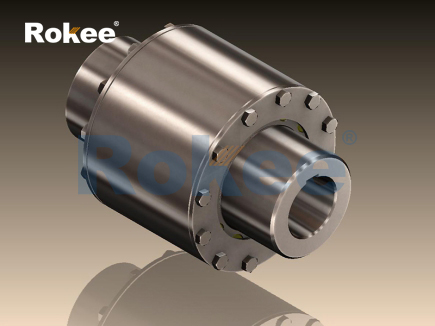
Conical Shaft Coupling is a specially designed mechanical connection device, characterized by the use of a combination of cone shaft and cone sleeve to transmit torque and motion. This type of coupling plays an important role in industrial transmission systems, especially suitable for applications that require high-precision alignment and reliable connections.
Compared with traditional parallel shaft couplings, the conical design provides unique advantages: the self-locking effect generated by the conical fit ensures high stability of the connection, while also facilitating installation and disassembly.
The typical structure of a tapered shaft coupling consists of the following key components:
Conical shaft: a precision machined conical surface with a standard ratio of 1:10 or 1:15 for taper
Cone sleeve: an inner conical hole component that matches the cone shaft, usually made of high-strength alloy steel
Tightening system: including axial compression bolts, hydraulic tensioning devices, or locking nuts, etc
Alignment components: Some models are equipped with special alignment rings or locating pins
The angle design of the conical contact surface is crucial, and there are three common standard cone angles: 6 °, 7 °, and 8 °. This geometric design creates a "wedge effect" that generates a significant radial clamping force under axial force, thereby achieving seamless power transmission.
The working principle of the conical shaft coupling is based on the friction torque generated by the conical fitting:
Installation stage: Use axial pre tightening force to tightly fit the cone sleeve with the cone shaft
Working stage: During torque transmission, the cone friction bears the main load
Self locking effect: The working load will increase the contact pressure, forming a self reinforcing mechanism
Common tapered shaft couplings in modern industry include:
Standard taper coupling: Basic type, with keyway or keyless design
Hydraulic cone coupling: using hydraulic installation technology to achieve ultra-high precision alignment
Expansion sleeve cone coupling: achieving uniform force through multi petal cone sleeves
Split type conical coupling: easy to maintain and replace
High elasticity conical coupling: integrated elastic element to cushion vibration
Special application fields have also developed specialized variants such as corrosion-resistant (stainless steel material), high-temperature (special alloy), and explosion-proof (intrinsic safety design).
The reason why tapered shaft couplings are favored in many industrial fields is mainly due to the following performance advantages:
High positioning accuracy: Radial and axial runout can be controlled within 0.01mm
Seamless transmission: eliminates reverse clearance, especially suitable for precision servo systems
High torque capacity: Increases load-bearing capacity by 30-50% compared to key connections of the same size
Easy to install: No heating or special tools required (except hydraulic type)
Easy maintenance: can be disassembled repeatedly without damaging the mating surface
Space saving: compact structure, small axial size
Conical Shaft Couplings are widely used in the following industries and equipment:
Machine tool industry: CNC machine tool spindle, rotary worktable, ball screw drive
Wind power equipment: connection between generator and gearbox
Metallurgical machinery: rolling mill transmission system, straightening equipment
Ship engineering: propulsion shaft system, deck machinery
Automation equipment: industrial robot joints, precision positioning systems
Pumps and Compressors: High Speed Turbomachinery
The correct selection of a tapered shaft coupling requires consideration of the following parameters:
Torque requirements: including rated torque and peak torque
Speed range: Pay attention to the critical speed limit
Shaft diameter size: standard series ranging from 10mm to 500mm
Environmental conditions: temperature, humidity, corrosiveness, etc
Requirements for alignment: radial, angular, and axial deviation tolerance
Dynamic characteristics: whether vibration damping function is required
Installation steps:
Clean all mating surfaces (lubricants are prohibited)
Preliminary alignment (it is recommended to use a laser alignment device)
Step by step uniform tightening (in cross order)
Check the contact mark after reaching the specified torque
Final accuracy verification (radial runout detection)
Maintenance suggestion:
Regularly check the pre tightening force of fasteners (must be rechecked after 50 hours of initial operation)
Monitor operating temperature (temperature rise not exceeding ambient temperature+30 ℃)
Check the wear of the cone surface every 2000 hours
Use specialized disassembly tools to avoid damage
Common faults include cone micro motion wear (countermeasures: increase surface hardness), looseness (countermeasures: switch to hydraulic fastening), and corrosion (solution: use coating protection).
The correct selection and use of tapered shaft couplings can significantly improve the reliability and energy efficiency of transmission systems, providing a powerful connection solution for modern industrial equipment.
pu sandwich panel line,pu sandwich panel machine,sandwich panel machine
« Conical Shaft Couplings » Latest Update Date: Dec 19, 2025
https://www.rokeecoupling.net/tags/conical-shaft-couplings.html