In the modern mechanical transmission industry, coupling components serve as indispensable connecting units that link two rotating shafts to transmit mechanical torque, and they play a vital role in stabilizing transmission systems, mitigating mechanical vibration, and compensating for shaft misalignment. Among various coupling types, disc membrane coupling has gradually become one of the most widely used transmission components in high-precision and high-speed mechanical equipment due to its unique elastic deformation mechanism, compact structural layout and excellent comprehensive mechanical properties. Different from traditional gear couplings and jaw couplings that rely on rigid contact or rubber elastic deformation for power transmission, disc membrane couplings adopt thin metal disc groups as the elastic deformation core, realizing flexible torque transmission through the micro elastic deformation of metal membranes. This special working principle endows the coupling with irreplaceable application advantages in complex working conditions such as high-speed rotation, harsh temperature environment and high-precision transmission requirements, making it widely applied in industrial production fields including mechanical manufacturing, energy power, aerospace and fluid transportation.

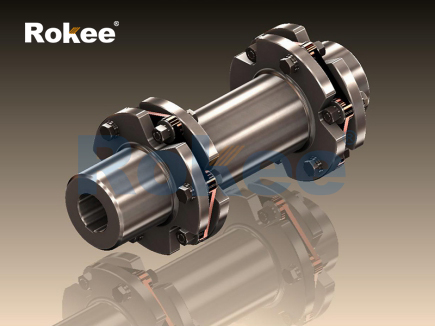
The internal structure of disc membrane coupling presents a highly compact and integrated design logic, and its overall composition is mainly composed of metal membrane groups, connecting fasteners, shaft hubs and intermediate sleeves. The metal membrane group is the core functional component of the coupling, which is usually made of high-strength stainless steel alloy materials with excellent fatigue resistance and tensile resistance. The membrane group is composed of multiple thin metal discs stacked together, and the thickness and stacking quantity of discs are adjusted according to different torque transmission requirements. Each metal disc is processed with symmetrically distributed connecting holes at the edge, which provides fixed installation positions for fasteners. High-strength metal bolts are selected as connecting fasteners, which can firmly connect the membrane group with the shaft hub and intermediate structure, ensuring no relative sliding between components during high-speed operation and maintaining zero-clearance transmission state. The shaft hub is the assembly structure connected with the rotating shaft, and its inner hole adopts smooth and precise machining to ensure tight fitting with the shaft body, effectively avoiding radial shaking caused by assembly gaps. For couplings with larger misalignment compensation requirements, an independent intermediate sleeve will be added between two groups of membrane structures. The intermediate sleeve is made of high-rigidity metal materials, which can isolate the vibration between the two shafts while improving the overall structural stability, and expand the space for axial and angular displacement compensation of the coupling. All structural components are processed by precision cutting and polishing technology, with smooth surface and low assembly tolerance, which lays a solid structural foundation for the stable operation of the coupling under extreme working conditions.
The unique structural design gives disc membrane coupling outstanding comprehensive performance, and its core performance advantages are prominently reflected in transmission rigidity, misalignment compensation, fatigue resistance and operational stability. In terms of torsional rigidity, the metal membrane maintains high rigidity in the torque transmission direction, which can effectively avoid torsional deformation and angle deviation during power transmission. This characteristic enables the coupling to accurately transmit rotational torque and angular displacement, meeting the high-precision transmission requirements of sophisticated mechanical equipment. In terms of misalignment compensation, the metal membrane can produce tiny elastic deformation under external force, which can simultaneously compensate for axial displacement, radial deviation and angular deflection between two connected rotating shafts. Axial compensation adapts to the linear expansion and contraction of the shaft body caused by temperature changes during equipment operation; radial compensation offsets the assembly deviation generated in the installation process; angular compensation adapts to the tiny inclination angle between the axes of the two shafts. Compared with other flexible couplings, the membrane structure has more balanced compensation ability in three displacement directions, and will not produce excessive deformation or stress concentration. In terms of fatigue resistance, the high-quality stainless steel membrane has stable mechanical properties, which can withstand repeated cyclic deformation during long-term high-speed rotation without material fatigue damage. Moreover, the all-metal structural design eliminates the aging and deterioration problems of non-metal elastic materials such as rubber and resin, so the coupling can maintain stable performance in high-temperature, low-temperature and corrosive working environments. In addition, the disc membrane coupling has excellent vibration damping and noise reduction capabilities. The micro-deformation of the membrane can absorb the vibration energy generated by shaft rotation, reduce the vibration amplitude of the transmission system, and avoid harsh mechanical noise caused by rigid friction between components. The whole structure does not need lubricating media such as lubricating oil and grease during operation, which simplifies daily maintenance procedures and avoids equipment failure and environmental pollution caused by lubricant deterioration and leakage.
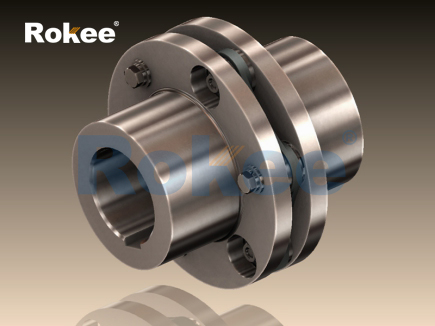
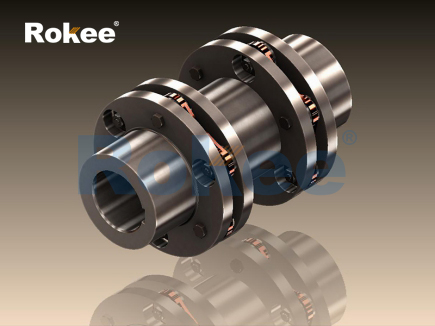
According to structural differences and functional characteristics, disc membrane couplings can be divided into multiple classification types, and the most common classification standard is based on the number of membrane groups and structural combination forms. Single disc membrane coupling is the simplest structural type, which consists of a single group of metal membranes and two independent shaft hubs. This coupling has a compact overall volume and a lightweight structure, and it is convenient for installation and disassembly. Its structural characteristics determine that it has excellent angular misalignment compensation ability, so it is suitable for mechanical equipment with small radial deviation and frequent angular displacement changes. However, limited by the single membrane structure, its axial compensation range is narrow, and it is not applicable to working conditions with large axial expansion and contraction of the shaft body. Double disc membrane coupling is composed of two groups of membrane structures and an intermediate connecting sleeve, which forms a separated elastic transmission structure. The intermediate sleeve can separate the two membrane groups spatially, effectively expanding the compensation range of axial and radial displacement. This type of coupling balances the compensation ability in three displacement directions, has stronger adaptability to complex installation deviations, and can bear larger torque load. It is the most widely used general-purpose type in industrial production. In addition, there are multi-layer reinforced membrane couplings. By increasing the stacking quantity of metal discs in a single membrane group, the structural strength and torque bearing capacity of the coupling are improved. This type of coupling is mostly used in heavy-duty mechanical equipment with high torque transmission demand, and it can maintain structural stability under long-term heavy load operation without plastic deformation of the membrane.
In addition to the above basic classification types, disc membrane couplings can also be classified according to assembly connection modes into keyway connection type and keyless locking connection type. The keyway connection type processes standard key grooves on the inner wall of the shaft hub, and transmits torque through the cooperation between flat keys and key grooves. This connection mode has simple processing technology and low assembly difficulty, which is suitable for conventional mechanical transmission equipment with general assembly precision requirements. The keyless locking connection type adopts the locking structure of elastic expansion sleeves, and realizes the tight connection between the shaft hub and the shaft body through the extrusion force generated by mechanical locking. It has no assembly gap in the connection part, avoids the torque fluctuation caused by key gap abrasion, and has higher connection precision and repeat positioning accuracy. This kind of connection structure is often matched with high-precision double-membrane couplings, which is widely used in sophisticated automation equipment. According to the applicable rotating speed range, the coupling can be divided into high-speed type and medium-low speed type. The high-speed type optimizes the membrane thickness and bolt distribution structure, reduces the overall mass and rotational inertia of the coupling, and can operate stably at an ultra-high rotating speed. The medium-low speed type adopts thickened membrane and reinforced shaft hub structure to prioritize structural stability and torque bearing capacity, adapting to low-speed and heavy-load operation scenarios.
With diversified structural types and excellent mechanical performance, disc membrane couplings have covered multiple industrial fields and realize differentiated application according to working condition characteristics. In the field of precision intelligent manufacturing, this coupling is applied to servo motor transmission systems, numerical control machine tools and automated robotic arms. These devices require extremely high transmission accuracy and response sensitivity, and the zero-clearance transmission characteristic and low rotational inertia of the coupling can ensure that the torque and displacement instructions are transmitted without delay, effectively avoiding processing errors and positioning deviations caused by transmission hysteresis. In the field of energy and power industry, the coupling is installed in power generation equipment such as steam turbines, wind power generators and large compressors. Such equipment runs continuously for a long time with high rotating speed and large vibration amplitude. The fatigue resistance and vibration damping performance of the metal membrane can adapt to long-term cyclic operation, reducing the failure rate of transmission components and extending the service life of power equipment. In the fluid transportation industry, disc membrane couplings are used to connect large water pumps, oil pumps and ventilation fans. The temperature change of fluid medium will cause thermal expansion and contraction of the shaft body, and the good axial compensation ability of the coupling can offset the displacement change caused by temperature difference, avoiding structural stress damage to the shaft body and connecting parts.
In heavy industrial manufacturing fields such as mining machinery and metallurgical rolling equipment, thickened multi-layer membrane couplings are selected to meet the heavy-load transmission demand. These mechanical devices bear large impact load and complex alternating stress during operation, and the high torsional rigidity and structural strength of the coupling can resist instantaneous impact torque, maintaining the stability of the transmission system. In addition, in the marine transportation industry, disc membrane couplings are applied to ship propulsion transmission systems. The all-metal structure can resist the corrosion of humid salt fog environment, and the reliable sealing and anti-corrosion performance ensure stable operation of the coupling in harsh marine working conditions. In the aerospace and medical equipment manufacturing industries, ultra-light high-precision single and double membrane couplings are adopted. These customized couplings are optimized in material selection and structural design to reduce self-weight while ensuring transmission accuracy, meeting the strict requirements of high-end sophisticated equipment for component precision and volume.
In the actual application process, the service life and operating effect of disc membrane coupling are affected by multiple external factors, among which installation accuracy and working environment are the key influencing elements. Excessive installation misalignment will cause the metal membrane to bear continuous excessive deformation stress, accelerating material fatigue and leading to membrane fracture in advance; therefore, it is necessary to strictly control the coaxiality error during installation. Extreme temperature environment will change the mechanical properties of metal materials, and too high or too low temperature will reduce the toughness and strength of the membrane. In addition, corrosive media such as chemical gas and salt fog will erode the surface of the metal structure, so it is necessary to carry out anti-corrosion treatment on the coupling surface for equipment in corrosive environments. Compared with other types of couplings, the only limitation of disc membrane coupling is the high requirement for installation precision. It cannot adapt to working conditions with excessive misalignment deviation, and the manufacturing cost of high-precision metal membrane is relatively higher than that of non-metal elastic couplings. However, with the continuous progress of mechanical processing technology, the structural optimization and batch production of disc membrane couplings are gradually reducing the application threshold, and their comprehensive application advantages in stability, durability and accuracy are becoming more prominent.
As the upgrading of modern mechanical transmission technology continues to advance, the industrial demand for high-efficiency, high-precision and long-life coupling components is constantly increasing. Disc membrane coupling, with its exquisite all-metal elastic structure, balanced comprehensive performance and wide scene adaptability, has become an important basic component supporting the operation of modern mechanical equipment. Its unique membrane deformation transmission principle breaks through the performance limitations of traditional flexible couplings, realizing the organic unity of high rigidity and flexible compensation. In the future, with the continuous innovation of metal material technology and precision processing technology, the structural design of disc membrane couplings will be further optimized, with lighter weight, higher torque density and stronger environmental adaptability. It will continue to expand its application boundary in emerging industrial fields such as new energy equipment and intelligent transportation, and provide more reliable basic guarantee for the efficient and stable operation of modern mechanical transmission systems.
pu sandwich panel line,pu sandwich panel machine,sandwich panel machine
« Disc Membrane Couplings » Latest Update Date: May 9, 2026
https://www.rokeecoupling.net/tags/disc-membrane-couplings.html