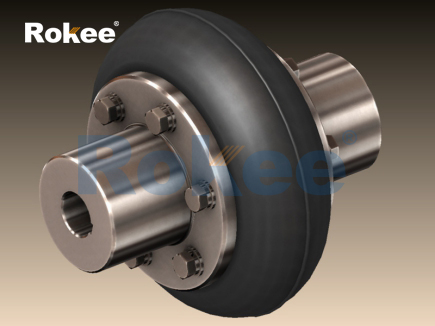
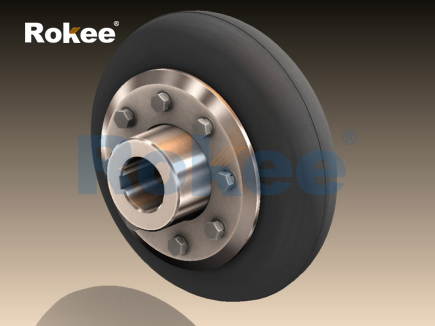
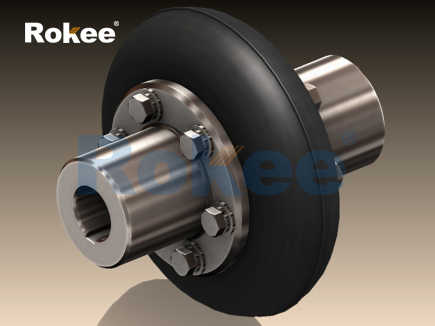
Tire couplings are essential flexible transmission components widely applied in modern mechanical transmission systems, serving the core function of connecting two independent rotating shafts to realize stable torque transmission while buffering mechanical vibration, absorbing impact loads, and compensating for shaft misalignment. As a type of elastic coupling with superior comprehensive performance, its entire working process relies on the elastic characteristics of the rubber tire elastic element and the mechanical coordination of metal structural parts, achieving efficient and stable power transmission under complex operating conditions. Unlike rigid couplings that rely on hard contact for torque transmission, tire couplings introduce elastic deformation as the core transmission medium, which fundamentally optimizes the stress state of the transmission system and greatly improves the adaptability and service life of mechanical equipment.
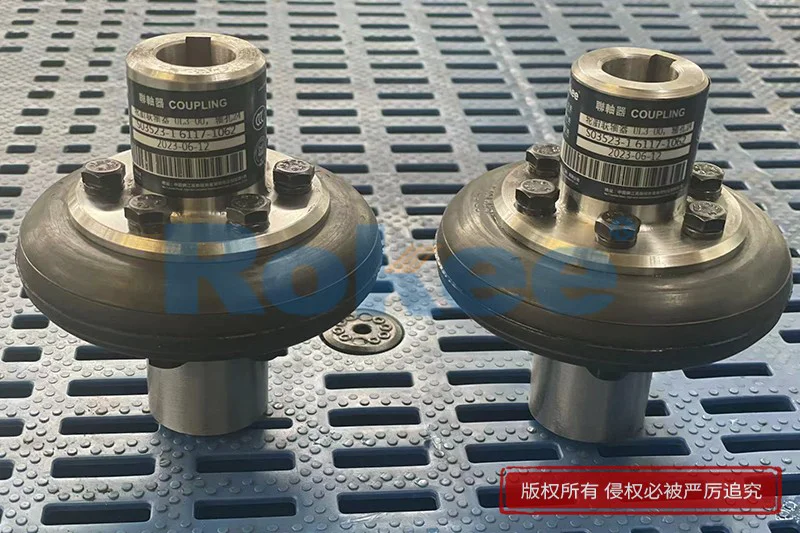
The basic structural composition of a tire coupling lays the foundation for its unique working principle. The overall structure is simple and compact, mainly composed of two symmetric metal flanges and an integral annular rubber tire elastic element. The metal flanges, manufactured from high-strength metal materials with excellent rigidity and wear resistance, are installed on the driving shaft and driven shaft respectively, serving as the rigid connection and force-bearing parts of the coupling. The core functional part is the vulcanized rubber tire element with a closed annular structure. This elastic component is internally reinforced with fiber cord layers and integrally vulcanized with rubber materials, possessing excellent torsional elasticity, shear resistance and fatigue resistance. The inner ring of the rubber tire is closely combined with the metal framework structure, and the whole tire body is clamped and fixed by the end faces of the two metal flanges during assembly. Relying on the pretightening force generated by bolt fastening, stable friction fit is formed between the tire element and the flanges, eliminating idle clearance during operation and ensuring synchronous power transmission. The entire structure requires no additional lubrication accessories, realizing maintenance-free operation in conventional working environments, which is also an important structural advantage derived from its working mechanism.
The core working logic of tire couplings is based on elastic torsional shear deformation and friction torque transmission. When the mechanical equipment starts to operate, the driving shaft drives the connected active flange to generate rotational motion. The active flange applies uniform circumferential friction and torsional force to the outer contact surface of the rubber tire element. Under the action of rotational torque, the rubber tire element does not produce rigid rotation immediately but undergoes controllable torsional shear deformation. This elastic deformation is the key link of power transmission. The deformation energy stored in the rubber tire is gradually released during the rotation process, stably transmitting the rotational torque from the active flange to the driven flange, and finally driving the driven shaft to rotate synchronously, completing the whole process of power transmission. In this working state, the rubber tire always maintains a flexible force transmission state, avoiding the rigid collision and hard extrusion between metal parts that exist in rigid transmission structures. The friction matching state between the tire element and the flanges remains stable within the rated torque range, and there is no relative sliding between the contact surfaces, ensuring high-efficiency and lossless transmission of torque.
In actual industrial operation, the coaxiality error between the driving shaft and the driven shaft is unavoidable due to machining errors, installation deviations, equipment operation vibration and structural deformation during long-term service. These errors will lead to three typical forms of shaft misalignment: parallel offset misalignment, angular deflection misalignment and axial displacement misalignment. The excellent misalignment compensation capability of tire couplings is another core embodiment of their working principle, which is realized through the multi-directional elastic deformation of the rubber tire element. When parallel offset occurs between the two shafts, the rubber tire produces uneven shear deformation in the radial direction, using its own elastic stretching and compression to offset the parallel position deviation of the shafts. When angular deflection exists between the two shafts, the tire element generates differential torsional deformation in the circumferential direction, adapting to the angle change of shaft rotation and avoiding additional bending stress on the shaft body. For the axial displacement caused by equipment thermal expansion and assembly gaps, the rubber tire can rely on its axial elastic compression and rebound to realize flexible adaptation. This multi-dimensional compensation function enables the coupling to always maintain a stable transmission state under shaft misalignment conditions, effectively avoiding additional mechanical stress, shaft bending and component wear caused by misalignment, and protecting the precision parts of the transmission system.
The vibration damping and impact absorption performance of tire couplings is closely linked to the viscoelastic characteristics of rubber materials, which constitutes an important part of their working principle. In the start-stop process, forward and reverse switching process and sudden load change process of mechanical equipment, instantaneous impact load and high-frequency vibration will be generated in the transmission system. For rigid transmission structures, these impact forces and vibration energy will be directly transmitted to the whole equipment, causing severe vibration, noise and structural fatigue damage. In contrast, the rubber tire element of tire couplings has good damping and energy dissipation properties. When impacted by instantaneous torque, the rubber tire produces large elastic deformation to absorb most of the impact energy, and gradually dissipates the residual energy in the form of internal friction of the material, avoiding instantaneous stress concentration in the transmission system. During continuous operation, the high-frequency micro-vibration generated by equipment operation will be filtered and attenuated by the viscoelastic effect of the rubber tire. The flexible connection state cuts off the vibration transmission path between the driving end and the driven end, effectively reducing the overall vibration amplitude of the equipment and lowering operating noise. This dynamic damping working mechanism makes tire couplings particularly suitable for working conditions with frequent start-stop, alternating load and strong vibration.
The torsional flexibility characteristics of tire couplings also endow the transmission system with excellent dynamic stability, which is a unique advantage formed by its working principle. The rubber tire element has low torsional stiffness and high elastic compliance, which can effectively adjust the dynamic response speed of the transmission system. When the system torque fluctuates slightly, the tiny torsional deformation of the tire can buffer the torque fluctuation, keep the rotating speed of the driven shaft uniform and stable, and avoid jitter and crawling of mechanical operation. In the process of load transition, the elastic delay effect of rubber deformation can smooth the torque transition curve, eliminate the torsional backlash existing in traditional rigid couplings, and realize backlash-free transmission. This stable dynamic transmission state can effectively reduce the alternating stress of gears, bearings, shafts and other key components in the transmission system, slow down the fatigue aging speed of parts, and significantly extend the overall service life of mechanical equipment.
The working performance of tire couplings is affected by operating environment and load changes, and its internal working mechanism will produce adaptive adjustment accordingly. In conventional temperature environments, the rubber material maintains stable elasticity and shear resistance, and the torque transmission and misalignment compensation functions operate normally. In low-temperature environments, the hardness of rubber materials increases slightly and the elasticity decreases moderately, and the coupling will appropriately reduce the deformation amplitude to ensure structural stability; in high-temperature environments, the rubber toughness is improved, and the damping and energy absorption capacity are enhanced, which can better adapt to the heat vibration generated by high-speed operation. Under light load conditions, the tire deformation is small, the transmission efficiency is extremely high, and the system operates stably; under heavy load conditions, the tire produces uniform and sufficient torsional deformation, fully exerts its buffer performance, and avoids structural damage caused by overload impact. In dusty, humid and slightly corrosive working environments, the integral rubber tire structure can isolate external pollutants, prevent the friction pair and connecting parts from being contaminated and worn, and maintain long-term stable transmission performance without daily maintenance.
Compared with other types of flexible couplings, the working principle of tire couplings shows obvious comprehensiveness and superiority. Spring couplings and gear couplings mainly rely on local structural deformation or meshing clearance to realize flexibility, with single compensation mode and limited damping effect, and are prone to wear and failure after long-term operation. Diaphragm couplings have high precision but poor impact resistance, and are easy to fatigue damage under frequent impact loads. Tire couplings integrate torque transmission, multi-dimensional misalignment compensation, vibration damping and impact resistance into one through the overall elastic deformation of the integral rubber element. The unified force-bearing and deformation structure avoids local stress concentration, has uniform internal force distribution during operation, and has strong structural fatigue resistance. Moreover, the integral tire structure has no split gaps, will not produce abnormal friction and impact noise during operation, and can always maintain low-noise and smooth operation in the full load range.
In the long-term continuous operation process, the working mechanism of tire couplings also shows good stability and recoverability. The elastic deformation of the rubber tire belongs to reversible elastic deformation within the rated working range. After the load and deformation are eliminated, the tire can quickly return to the initial state without permanent structural deformation, ensuring the long-term repeated working accuracy of the coupling. The fiber cord reinforcement layer inside the rubber tire effectively improves the overall structural strength, limits the excessive deformation of rubber materials under extreme load, avoids tearing and damage of the elastic element, and ensures the safety and reliability of power transmission. The friction matching state between the tire and the flange will not fail due to long-term operation. The stable pretightening force and uniform friction contact ensure that the transmission efficiency will not decrease with the extension of service time, realizing long-term stable operation of the transmission system.
In summary, the working principle of tire couplings takes the elastic torsional shear deformation and friction transmission of the integral rubber tire element as the core, and realizes efficient and stable power transmission through the flexible coordination with metal flange structures. It integrates multiple functions such as shaft misalignment compensation, vibration damping and noise reduction, impact load absorption and dynamic load smoothing, and solves many pain points of rigid and single-function flexible couplings in industrial transmission. Its simple and reliable working mechanism, excellent environmental adaptability and long-term operational stability make it widely applicable in various mechanical transmission scenarios such as general machinery, conveying equipment, power machinery and engineering machinery. With the continuous development of mechanical industry towards high speed, high load and high stability, the unique flexible transmission working principle of tire couplings will continue to play an important role in improving the operational reliability and service life of mechanical equipment.
- Tags:
- Tire Couplings ,
- Rubber Tire Couplings ,
- sandwich panel line ,
- sandwich panel machine
- pu sandwich panel machine
« Working Principle of Tire Couplings » Latest Update Date: Jun 3, 2026
https://www.rokeecoupling.net/blog/working-principle-of-tire-couplings.html