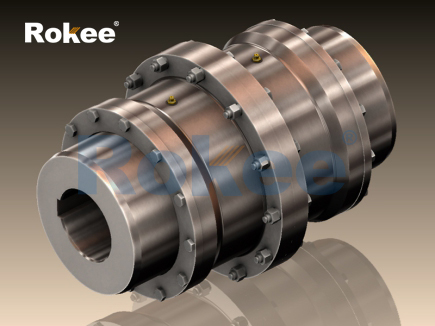
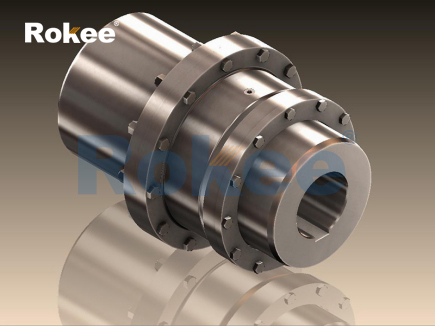
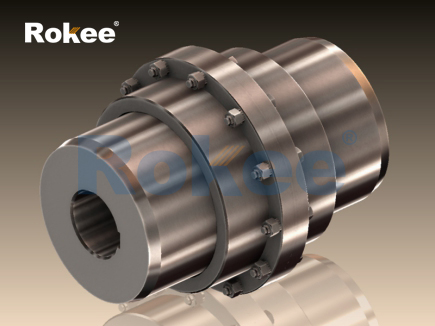
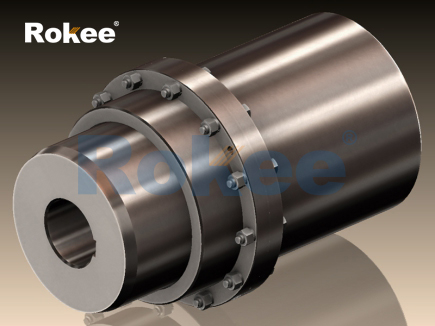
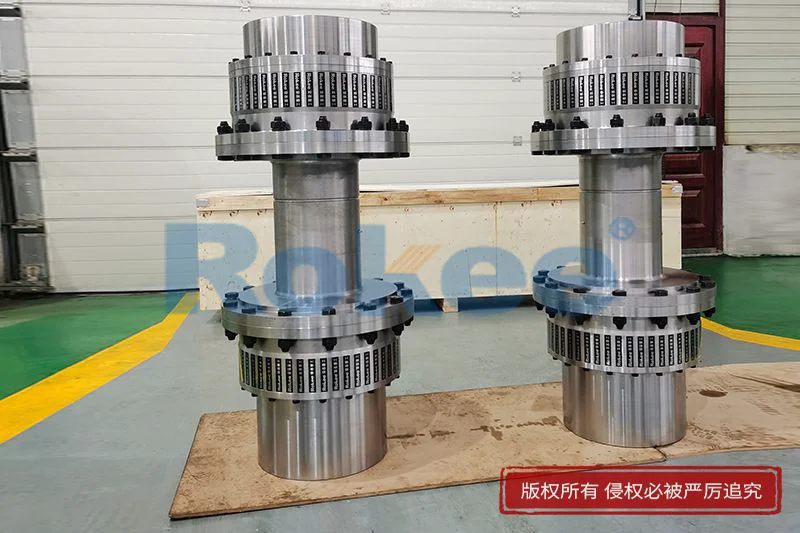
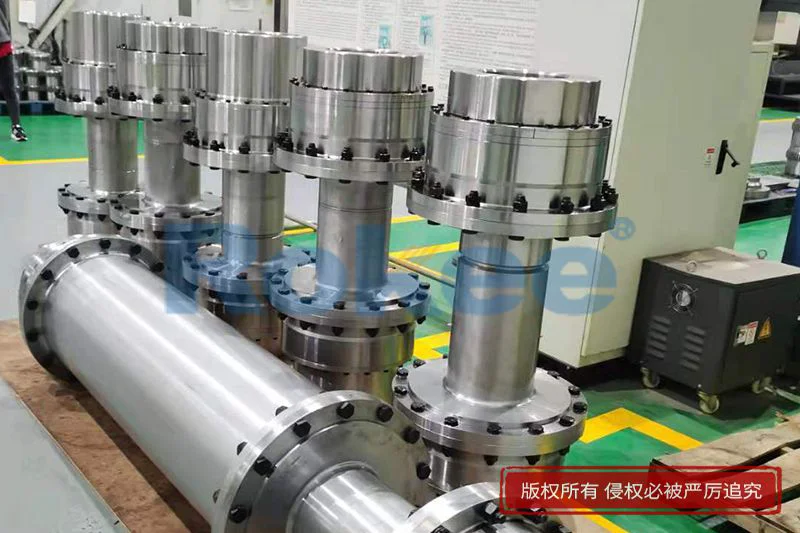
Drum Gear Coupling With Intermediate Shaft
Rokee is a well-known Drum Gear Coupling supplier from china, the page show cases of Drum Gear Coupling With Intermediate Shaft, provide customized services based on user's drawings, and supporting exports.
In modern mechanical transmission systems, the rational connection of rotating shafts directly determines the operational stability, transmission efficiency, and service life of mechanical equipment. As a vital rigid-flexible transmission component, drum gear coupling with intermediate shaft has gradually become an indispensable core part in heavy-duty and long-distance shaft connection scenarios by virtue of its unique structural design and excellent comprehensive performance. This type of coupling optimizes the traditional drum gear coupling structure by adding an intermediate shaft, which effectively solves the alignment difficulties and transmission limitations of ordinary gear couplings in long-span shafting transmission. It can steadily transmit torque while adapting to various complex shaft displacement deviations, providing reliable connection solutions for various large-scale industrial mechanical equipment.

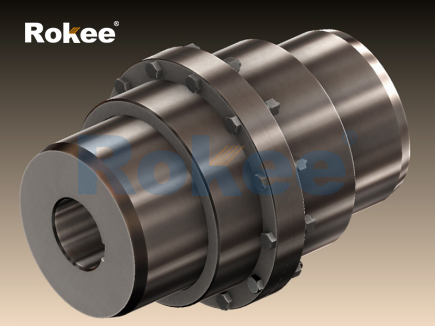
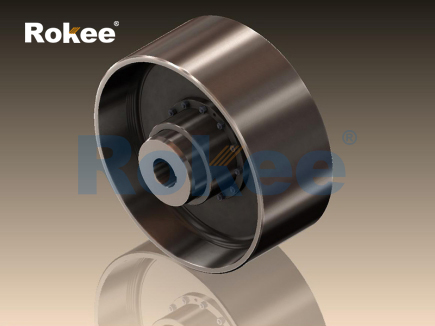
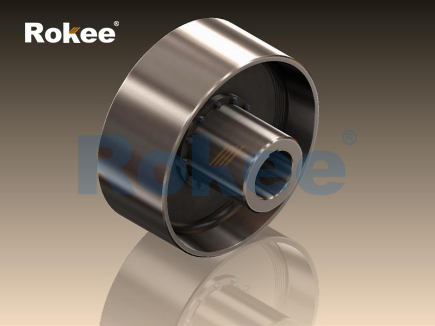
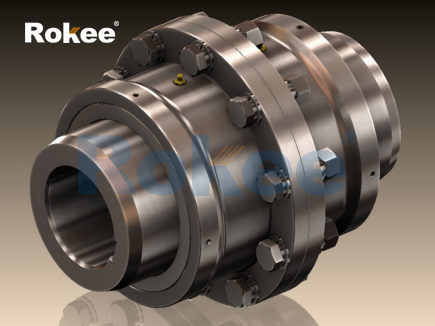
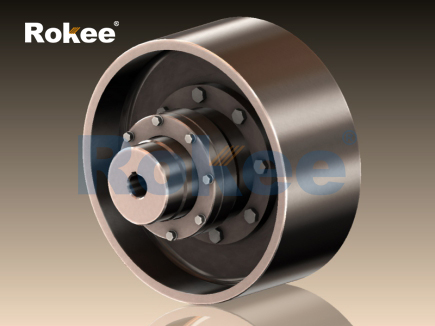
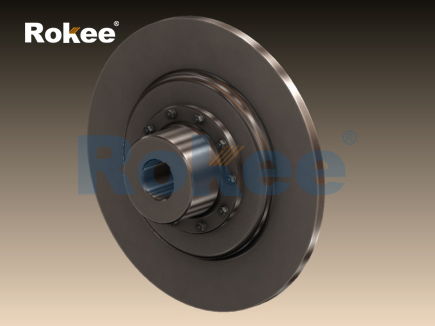
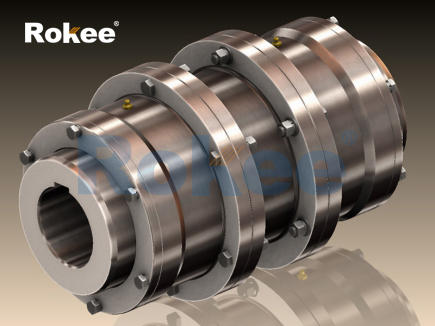
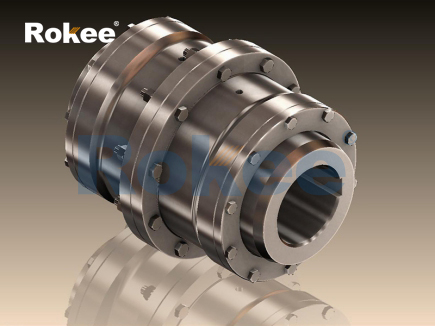
The overall structure of drum gear coupling with intermediate shaft adopts a symmetrical combined layout, mainly composed of two half-couplings with drum-shaped outer teeth, integral forged intermediate transmission shaft, precision inner gear sleeves, high-strength connecting fasteners and multi-layer sealing assemblies. Different from straight tooth gear couplings, the outer teeth of the half-couplings are processed into spherical drum-shaped profiles through precision modification technology. The spherical center of the tooth surface coincides with the axis of the coupling, and this optimized tooth profile design fundamentally improves the stress distribution state of the meshing teeth. The intermediate shaft adopts an integral forging process instead of the traditional split splicing structure, which enhances the overall structural rigidity and deformation resistance of the shaft body. During high-speed and heavy-load operation, the intermediate shaft can maintain excellent linearity without obvious shaking or torsional deformation, ensuring the continuity and stability of power transmission. The inner gear sleeves are matched with drum-shaped outer teeth to form a flexible meshing pair, and the reasonably optimized tooth side gap reserves sufficient deformation space for the meshing teeth, enabling the coupling to bear larger angular displacement deviation in the working process.
The internal transmission principle of drum gear coupling with intermediate shaft follows the mechanical meshing theory of gear transmission. In the actual working process, the driving equipment drives one side of the half-coupling to rotate, and the drum-shaped outer teeth mesh with the inner teeth of the gear sleeve to transmit torque to the intermediate shaft. Then the intermediate shaft synchronously drives the other side of the gear sleeve and half-coupling to operate, realizing the long-distance power transmission between the driving shaft and the driven shaft. The drum-shaped tooth profile can effectively reduce the stress concentration at the tooth root and tooth surface. When the shaft system produces radial, angular and axial displacements due to installation errors, equipment vibration or thermal expansion, the meshing teeth can produce slight sliding and deflection along the spherical surface. This flexible meshing mode will not generate additional restraint stress on the shaft system, and can automatically compensate for various displacement deviations generated during equipment operation. Compared with ordinary couplings, this coupling has a more scientific force transmission path. The load is evenly distributed on each meshing tooth surface, avoiding local excessive wear and tooth surface fatigue damage caused by concentrated stress.
In terms of material selection, all key load-bearing components of drum gear coupling with intermediate shaft are made of high-performance alloy steel with excellent mechanical properties. After carburizing, quenching and high-temperature tempering heat treatment, the tooth surface hardness is significantly improved, with strong wear resistance and contact fatigue resistance. The intermediate shaft undergoes strict forging and finishing processes to eliminate internal material defects, enhance the structural toughness and torsional resistance of the shaft body, and ensure that it can withstand long-term alternating loads in harsh working environments. The sealing components are made of high-temperature and wear-resistant rubber and composite metal materials, which are installed at the connection gaps of the gear sleeves. The closed sealing structure can effectively isolate external dust, moisture and corrosive substances, prevent internal lubricating grease from leakage, and maintain a stable lubrication state of the meshing tooth surface for a long time. The connecting fasteners are made of high-strength alloy materials, which have excellent tensile and shear resistance, and will not loosen or slip under strong vibration and impact loads.
Drum gear coupling with intermediate shaft has prominent comprehensive performance advantages compared with other types of mechanical couplings. In terms of displacement compensation capability, it can adapt to angular displacement deviation within a reasonable range, and has excellent radial and axial displacement compensation effects. This performance makes it suitable for equipment with high installation difficulty and large shaft position deviation. In terms of load-bearing capacity, the drum-shaped tooth structure increases the effective contact area of meshing teeth. Under the same volume specification, its torque bearing capacity is significantly higher than that of straight tooth couplings and elastic couplings, and it can operate stably in low-speed and heavy-load working conditions. The transmission efficiency of the coupling remains at a high level, and the friction loss generated during the meshing transmission process is extremely low, which effectively reduces the energy consumption of mechanical operation. In addition, the integral intermediate shaft structure improves the overall rigidity of the coupling, suppresses the amplitude of vibration generated during shaft system operation, reduces transmission noise, and optimizes the operating environment of the equipment.
This type of coupling has a wide range of application coverage in the industrial field, and is widely used in heavy industrial machinery that requires long-distance shaft connection and high torque transmission. In the metallurgical industry, it is applied to the connection of rolling mill transmission shafts, adapting to the high-load and continuous operating working conditions of rolling equipment, and maintaining stable power output during metal rolling processing. In the mining industry, it serves for ball mills, hoists and crushing machinery. The complex working environment of mining equipment is accompanied by frequent vibration and impact loads, and the coupling's excellent shock absorption and deviation compensation performance can effectively buffer mechanical impact and prolong the service life of transmission components. In the field of building materials and chemical industry, it is matched with large-scale mixing equipment and rotary kiln equipment to solve the problem of difficult alignment of long-distance shafts and ensure the continuous operation of production lines. Moreover, it also has stable application effects in port handling machinery, water conservancy power equipment and marine transmission systems, providing reliable connection guarantees for various heavy-duty mechanical transmission systems.
The installation and commissioning process of drum gear coupling with intermediate shaft follows standardized mechanical operation specifications, and the integral intermediate shaft design simplifies the assembly steps to a certain extent. Before installation, it is necessary to carefully check the processing quality of each component, remove burrs and impurities on the tooth surface and shaft hole, and confirm that there is no damage or defect on the surface of key parts. During the installation process, the coaxiality of the driving shaft and the driven shaft should be strictly controlled. Although the coupling has displacement compensation capability, excessive installation deviation will increase the meshing friction of the tooth surface and accelerate component wear. The connecting fasteners need to be tightened evenly in a symmetrical order to avoid stress imbalance caused by inconsistent fastening force. After the installation is completed, it is necessary to inject high-viscosity lubricating grease into the closed gear meshing cavity. The lubricating grease can form a uniform oil film on the tooth surface, reduce meshing friction, and also play a role in heat dissipation, rust prevention and noise reduction.
Daily maintenance and inspection are crucial to extend the service life of drum gear coupling with intermediate shaft. In the regular maintenance work, the sealing performance of the sealing assembly should be checked first. If grease leakage or sealing aging is found, the sealing parts need to be replaced in time to prevent external impurities from entering the meshing cavity and causing tooth surface abrasion. The fastening state of the connecting bolts should be inspected regularly, and the loose bolts should be tightened to avoid structural vibration caused by loose parts during operation. It is necessary to replace the internal lubricating grease on a regular cycle. The deteriorated and contaminated lubricating grease will lose its lubricating and protective effects, increasing the wear degree of the meshing teeth. In addition, the operating vibration and noise of the coupling should be monitored in real time during the operation of the equipment. Once abnormal vibration or harsh noise occurs, the equipment should be shut down for inspection to eliminate hidden dangers such as tooth surface wear, shaft body deformation and bolt loosening.
In the actual application process, drum gear coupling with intermediate shaft also has certain usage restrictions and optimization directions. It has poor adaptability to ultra-high-speed working conditions, and centrifugal force will affect the meshing stability of the tooth surface when running at an excessively high speed, so it is more suitable for low and medium-speed heavy-load transmission scenarios. Compared with elastic couplings, its vibration damping performance is limited, and it cannot completely eliminate high-frequency vibration. With the continuous upgrading of industrial manufacturing technology, the production process of this coupling is also constantly optimized. Advanced precision machining technology is used to further improve the machining accuracy of the tooth surface and the flatness of the intermediate shaft. New high-strength and corrosion-resistant alloy materials are applied to enhance the environmental adaptability of the coupling in high-temperature, humid and corrosive working environments. At the same time, the structural design is continuously simplified to reduce the difficulty of later disassembly, maintenance and replacement, and lower the overall operation cost of mechanical equipment.
From the perspective of industrial development trend, with the continuous expansion of the scale of heavy industry and the continuous improvement of mechanical automation, the demand for long-distance and high-power shaft transmission equipment is increasing. Drum gear coupling with intermediate shaft, as a professional heavy-duty transmission component, will have broader application prospects in the industrial field. Its unique intermediate shaft structure makes up for the transmission defects of ordinary gear couplings in long-span shafting, and its excellent bearing capacity and stability meet the rigorous use requirements of modern heavy machinery. In the future, with the integration of intelligent detection technology, the coupling will realize real-time monitoring of operating parameters such as tooth surface wear, temperature and vibration, further improving the safety and intelligence level of equipment operation. Relying on continuous technological innovation and structural optimization, this coupling will continue to play an irreplaceable role in heavy industrial transmission systems, providing stable and efficient connection guarantees for the sustainable operation of various mechanical equipment.
With excellent quality, we have been continuously providing many coupling products of various categories and uses complying with multiple standards and a full range of services, from the product selection to final installation and operation, for the industry fields of ferrous metallurgy, nuclear power, gas turbine, wind power, ropeway construction, lifting transportation, general equipment, etc.
pu sandwich panel line,pu sandwich panel machine,sandwich panel machine
« Drum Gear Coupling With Intermediate Shaft » Latest Update Date: May 9, 2026
https://www.rokeecoupling.net/cases/drum-gear-coupling-with-intermediate-shaft.html
Products
![GICL Crown Gear Coupling]() GICL Crown Gear Coupling
GICL Crown Gear Coupling![GICLZ Crown Gear Coupling]() GICLZ Crown Gear Coupling
GICLZ Crown Gear Coupling![GIICL Crown Gear Coupling]() GIICL Crown Gear Coupling
GIICL Crown Gear Coupling![GIICLZ Crown Gear Coupling]() GIICLZ Crown Gear Coupling
GIICLZ Crown Gear Coupling![GCLD Crown Gear Coupling]() GCLD Crown Gear Coupling
GCLD Crown Gear Coupling![NGCL Crown Gear Coupling]() NGCL Crown Gear Coupling
NGCL Crown Gear Coupling![NGCLZ Crown Gear Coupling]() NGCLZ Crown Gear Coupling
NGCLZ Crown Gear Coupling![WG Crown Gear Coupling]() WG Crown Gear Coupling
WG Crown Gear Coupling![WGZ Crown Gear Coupling]() WGZ Crown Gear Coupling
WGZ Crown Gear Coupling![WGP Crown Gear Coupling]() WGP Crown Gear Coupling
WGP Crown Gear Coupling![WGT Crown Gear Coupling]() WGT Crown Gear Coupling
WGT Crown Gear Coupling![WGC Crown Gear Coupling]() WGC Crown Gear Coupling
WGC Crown Gear Coupling![WGJ Crown Gear Coupling]() WGJ Crown Gear Coupling
WGJ Crown Gear Coupling