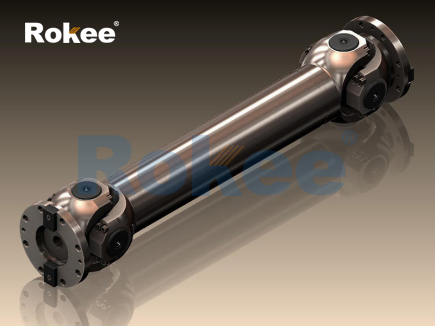
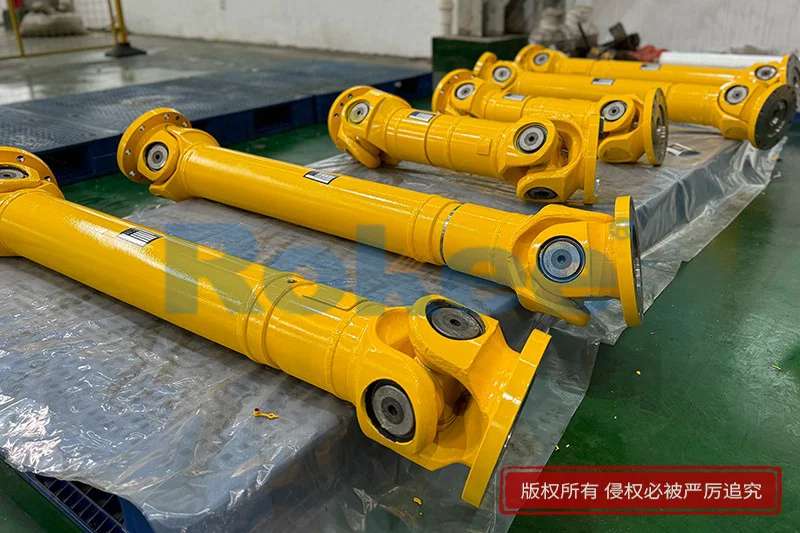
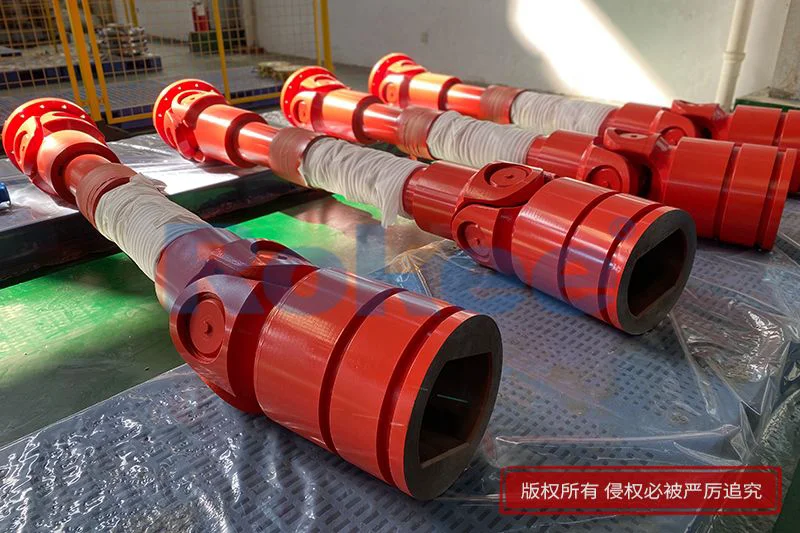
Double Universal Joint Coupling
Rokee is a well-known Double Universal Joint Coupling supplier from china, the page show cases of Double Universal Joint Coupling, provide customized services based on user's drawings, and supporting exports.
In the intricate ecosystem of mechanical transmission systems, the seamless transfer of rotational power between disjointed shafts stands as one of the most fundamental yet challenging engineering requirements. Among various mechanical connecting components, double universal joint couplings have emerged as an indispensable transmission element, uniquely engineered to address the limitations of single joint structures and deliver stable power transmission under complex spatial misalignment conditions. This mechanical component features a tandem arrangement of two universal joint units connected by an intermediate shaft, distinguishing itself from basic single universal joints with optimized kinematic performance and broader environmental adaptability. Its rational structural design and reliable mechanical properties enable it to serve a wide spectrum of mechanical equipment, ranging from general industrial machinery to heavy-duty engineering facilities, consistently maintaining efficient power conveyance in harsh working environments where shaft displacement and angular deviation are unavoidable.
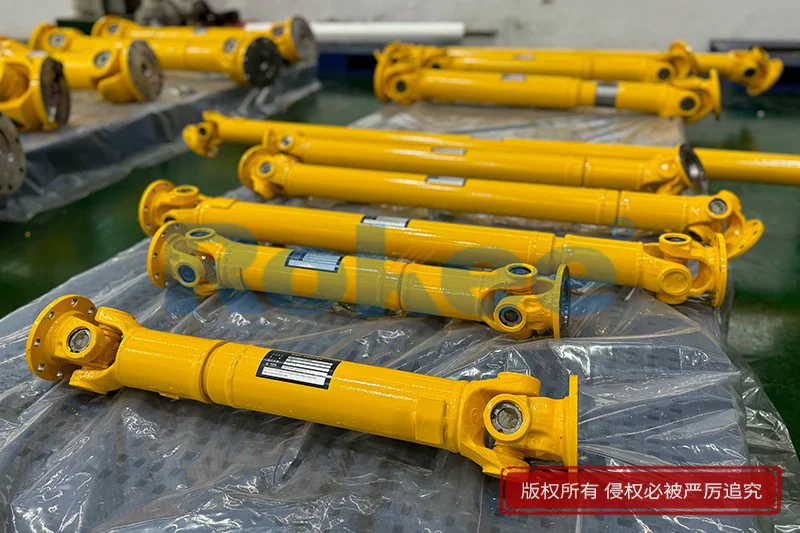
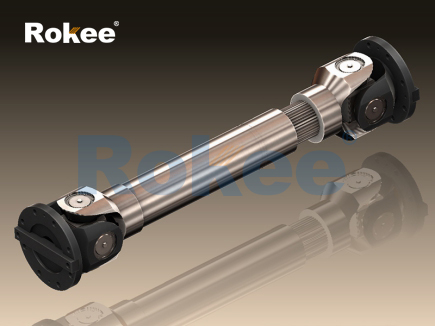
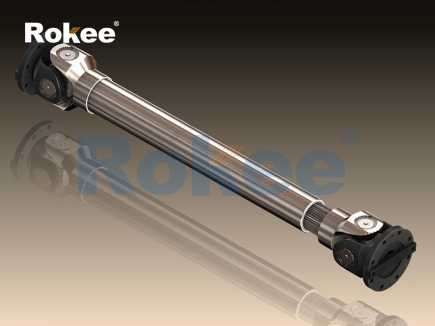
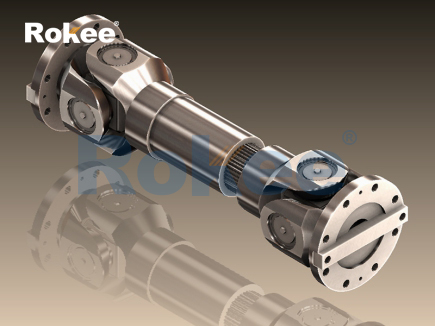
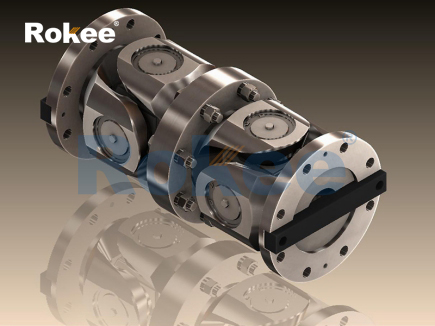
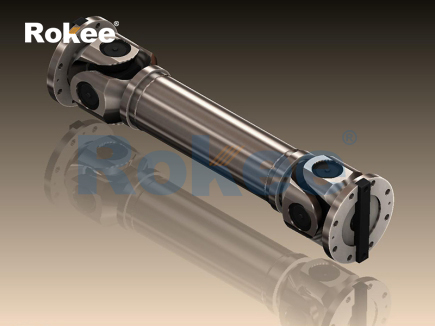
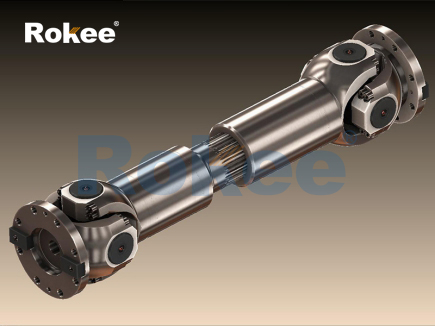
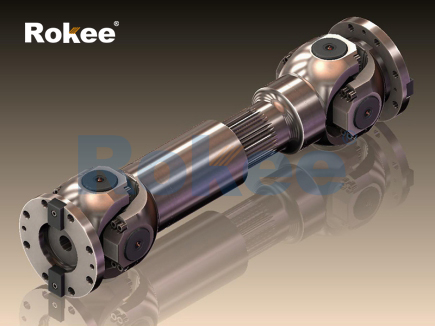
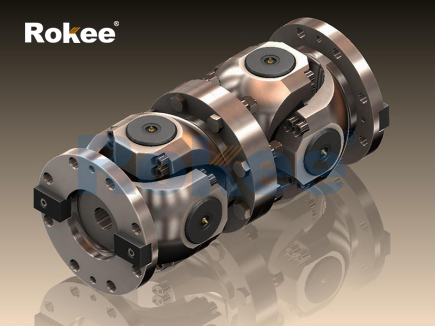
The fundamental structural composition of double universal joint couplings follows a concise and practical mechanical logic, with every component designed to optimize transmission stability and load-bearing capacity. The entire assembly mainly consists of two identical single universal joints, a hollow or solid intermediate shaft, and reinforced connecting accessories. Each single universal joint contains a cross-shaped shaft, bearing assemblies, and joint yokes, where the cross-shaped shaft acts as the core hinged component to connect adjacent yokes and realize flexible angular movement between connected shafts. The intermediate shaft serves as a transitional connecting medium between the two joints, rationally spacing the two universal units to create favorable kinematic conditions for constant-speed transmission. All metal structural parts are fabricated from high-strength alloy materials through precise forging and heat treatment processes, eliminating internal structural defects and enhancing overall rigidity and wear resistance. The bearing components embedded in the joint yokes adopt smooth rolling structures, which effectively reduce friction resistance during rotational operation and minimize mechanical loss in the power transmission process. Unlike rigid coupling structures that rely on integrated fixed connection, the hinged assembly mode of double universal joint couplings endows each joint with independent rotational freedom, laying a solid structural foundation for adapting to multi-dimensional shaft displacement.
A core advantage of double universal joint couplings lies in their optimized kinematic transmission principle, which effectively overcomes the inherent speed fluctuation defect of single universal joints. A single universal joint inevitably produces periodic angular velocity variation during operation when there is an included angle between the driving shaft and the driven shaft. This non-constant speed characteristic leads to unstable transmission torque, additional mechanical vibration, and cyclic fatigue load on components, severely restricting the service life and operating stability of mechanical equipment. The double-section structure of double universal joint couplings perfectly compensates for this technical flaw by setting two universal joints with symmetric deflection angles. During operation, the speed fluctuation generated by the first universal joint is precisely offset by the reverse speed change generated by the second joint, ensuring that the angular velocity of the driving shaft and the driven shaft remains consistent throughout the rotation cycle. This constant-speed transmission mechanism fundamentally reduces torsional vibration and impact load in the transmission system, enabling the connected mechanical shafts to maintain smooth and synchronized rotational motion even under large-angle deflection conditions. The rational matching of spatial angles between the two joints becomes the key to realizing constant-speed transmission, requiring precise calculation and strict control of assembly angles during the manufacturing and installation stages.
Double universal joint couplings possess excellent multi-directional displacement compensation capability, which is one of the critical reasons for their wide application in complex mechanical systems. In actual industrial production scenarios, mechanical shafts inevitably produce various displacements due to installation errors, equipment vibration, thermal expansion and contraction of materials, and foundation subtle settlement. These displacements are categorized into angular displacement, radial offset, and axial displacement, all of which can cause additional stress on traditional rigid couplings and accelerate component wear. The unique hinged structure of double universal joint couplings can simultaneously adapt to these three types of displacements. The swing angle of a single joint allows the coupling to tolerate a certain range of angular deviation between shafts, while the combined action of the two joints expands the adaptable angle range significantly. The intermediate shaft can undergo tiny radial and axial displacement along with the connected shafts, buffering the dislocation stress generated during equipment operation. This outstanding compensation performance greatly reduces the installation accuracy requirements of mechanical equipment, lowering the time cost of shaft alignment and simplifying the overall assembly process of transmission systems. In long-term continuous operation, it can also absorb minor position changes of mechanical components caused by environmental factors, maintaining stable connection status between shafts.
In terms of mechanical performance, double universal joint couplings exhibit outstanding torsional rigidity and impact resistance, making them suitable for medium and heavy-load transmission working conditions. The high-strength alloy materials and integrated forging process ensure that each structural component has excellent mechanical strength, enabling the coupling to withstand large instantaneous torque and cyclic alternating load without permanent deformation. The optimized contact structure between the cross shaft and bearings realizes uniform load distribution, avoiding local stress concentration that easily occurs in ordinary connecting parts. Even in working scenarios with frequent startup, shutdown, and sudden load changes, the coupling can buffer instantaneous impact force through flexible hinged movement, protecting driving components such as motors and reducers from rigid impact damage. Meanwhile, the surface of key moving parts undergoes special wear-resistant treatment, which reduces abrasive wear caused by long-term friction and extends the stable service cycle of the coupling. Compared with elastic couplings that rely on flexible deformation of non-metallic materials, all-metal double universal joint couplings have better high-temperature resistance and aging resistance, capable of maintaining stable mechanical performance in high-temperature, dusty, and humid harsh working environments.
The application scenarios of double universal joint couplings cover numerous industrial fields, showing strong environmental adaptability and engineering practicability. In the transportation machinery industry, they are applied to the power transmission structures of various mobile equipment, realizing stable power connection between deflected transmission shafts during driving and ensuring the flexibility of mechanical movement. In metallurgical and mining machinery, such couplings undertake the heavy-load transmission work of rolling mills, crushers, and conveying equipment. Their vibration resistance and displacement compensation ability adapt to the harsh working conditions of heavy dust and strong vibration in mining areas. In agricultural machinery, they serve the power transmission systems of tillage and harvesting equipment, freely adjusting the connection angle with the fluctuation of complex terrain to guarantee uninterrupted power output. Additionally, they are widely used in general industrial equipment such as printing machinery, packaging equipment, and hydraulic transmission devices. Whether in low-speed heavy-load operation or medium-speed continuous rotation scenarios, double universal joint couplings can match the operating requirements of mechanical systems, providing reliable basic support for the normal operation of various equipment.
To maintain the long-term stable working performance of double universal joint couplings, standardized daily maintenance and scientific operation management are essential. Lubrication management stands as the core of maintenance work; high-performance lubricants need to be regularly injected into the internal bearing and hinged friction pairs to form a uniform lubricating oil film. This oil film can reduce metal friction and wear, lower operating temperature, and alleviate mechanical vibration and noise. During the equipment inspection process, staff should regularly check the tightness of connecting fasteners to prevent component loosening caused by long-term vibration, which may lead to transmission clearance and abnormal noise. It is also necessary to observe the surface wear of key components such as cross shafts and bearing rollers, replacing severely worn parts in a timely manner to avoid mechanical failure caused by component aging. In the daily operation of mechanical equipment, excessive deflection angles and overload operation should be avoided to prevent irreversible fatigue damage to the coupling structure. Reasonable storage measures are also required for idle couplings; they need to be placed in a dry and ventilated environment to prevent metal corrosion, and protective measures should be taken to avoid extrusion deformation of structural parts.
With the continuous progress of modern mechanical manufacturing technology, the production and optimization technology of double universal joint couplings is also constantly upgrading. Advanced precision machining equipment is adopted in the manufacturing process to improve the dimensional accuracy and surface smoothness of components, reducing assembly gaps and friction resistance. New high-strength and corrosion-resistant alloy materials are gradually applied to product processing, further enhancing the mechanical performance and environmental adaptability of couplings. In terms of structural optimization, designers continuously adjust the spatial layout of intermediate shafts and joint yokes to minimize the overall structural size while ensuring load-bearing capacity, making the couplings more adaptable to compact mechanical installation spaces. Moreover, the bionic mechanical structure and intelligent stress monitoring technology are being integrated into the design iteration of double universal joint couplings, realizing real-time monitoring of internal stress and wear status during operation, which provides data support for predictive maintenance of equipment.
In conclusion, double universal joint couplings occupy an irreplaceable important position in the field of mechanical transmission by virtue of their unique double-section joint structure, constant-speed transmission characteristics, excellent displacement compensation ability, and reliable load-bearing performance. They effectively solve various connection difficulties in mechanical shaft transmission, break through the usage limitations of single universal joints and rigid couplings, and provide stable and efficient power transmission solutions for diverse mechanical equipment. With the continuous development of industrial modernization and the upgrading of mechanical equipment towards high precision, high load, and high stability, the technical optimization potential of double universal joint couplings will be further explored. Through material innovation, structural improvement, and intelligent upgrading, this classic mechanical connecting component will continuously adapt to more complex and extreme working conditions, making more valuable contributions to the stable operation and technological progress of the modern mechanical industry.
With excellent quality, we have been continuously providing many coupling products of various categories and uses complying with multiple standards and a full range of services, from the product selection to final installation and operation, for the industry fields of ferrous metallurgy, nuclear power, gas turbine, wind power, ropeway construction, lifting transportation, general equipment, etc.
pu sandwich panel line,pu sandwich panel machine,sandwich panel machine
« Double Universal Joint Coupling » Latest Update Date: May 9, 2026
https://www.rokeecoupling.net/cases/double-universal-joint-coupling.html