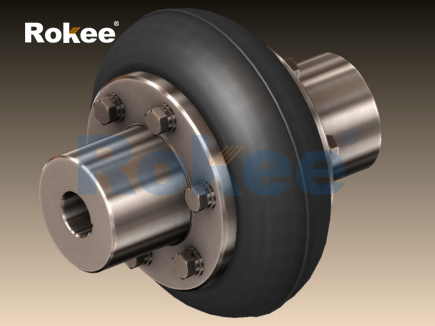
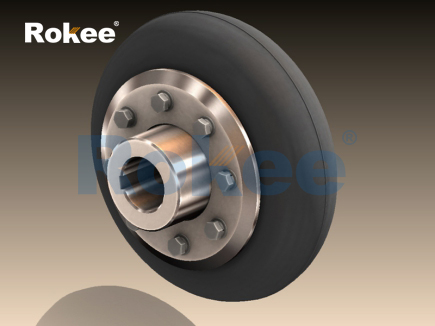
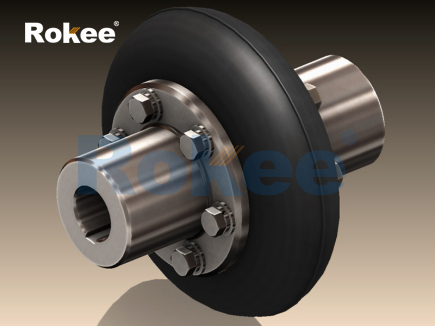
Tyre couplings belong to the category of flexible shaft couplings, which rely on elastic tyre components to transmit torque between two rotating shafts while accommodating different types of misalignment. At the core of their working principle lies the deformation characteristic of the rubber tyre element fitted between the two hub halves mounted on the driving and driven shafts. When the driving shaft begins to rotate, torque is transferred mechanically from the driving hub to the outer surface of the tyre. The tyre undergoes controlled elastic distortion rather than rigid displacement, passing rotational force onward to the driven hub and the connected equipment. Unlike rigid couplings that require near-perfect shaft alignment, the tyre element can bend, stretch and compress within its designed elastic range as the shafts deviate from ideal coaxial positions. This elastic medium acts as a buffer between the two sides of the transmission system. Any sudden fluctuations in torque generate temporary strain on the tyre, which absorbs the peak force and slows the rate of force transfer to the downstream machinery. This basic mechanism separates tyre couplings from many other flexible coupling designs, because the continuous ring-shaped tyre structure distributes stress evenly across its whole circumference during operation, instead of concentrating load on discrete elastic blocks or pins. Even under steady rotation, minor axial movement, angular offset and parallel displacement between shafts are compensated by the flexible tyre, preventing mechanical binding and excessive contact pressure between metallic hub parts.
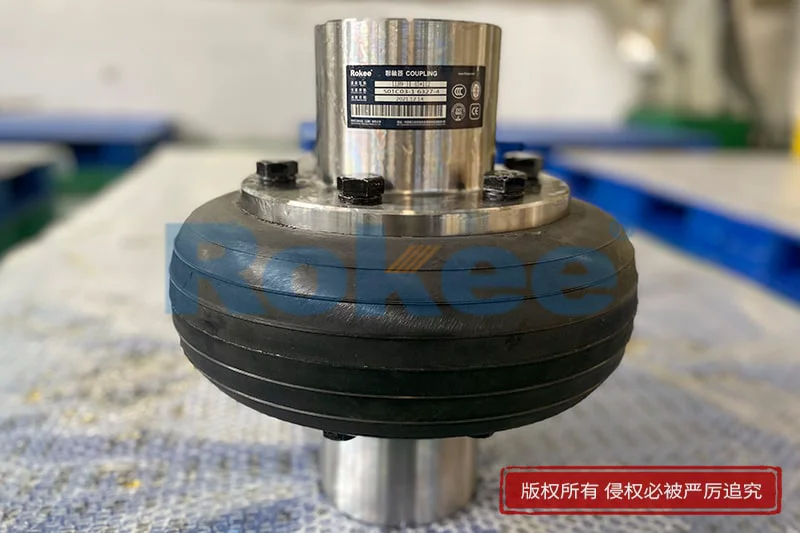
The ability to accept multiple forms of shaft misalignment is one of the most practical features enabled by the working principle of tyre couplings. Parallel misalignment occurs when two shafts sit side by side at the same angle but with a horizontal gap between their central lines. Angular misalignment appears when shaft centre lines intersect at a slight angle, and axial misalignment refers to small back-and-forth movement of shafts along their rotation axis. The tyre element can simultaneously handle all three types of misalignment within its operating limits. As misalignment exists, different sections of the tyre experience varying degrees of tension and compression during each full rotation cycle. Parts of the tyre stretch when pulled between the offset hub surfaces, while other sections compress as the hubs push inward. The material’s elasticity allows these cyclic shape changes to repeat continuously without permanent deformation as long as misalignment stays within the allowable range. If rigid couplings were used under the same shaft offset conditions, repeated bending stress would build up on shaft ends, bearings and seals, leading to accelerated wear and unexpected breakdown. The tyre does not eliminate misalignment itself, but converts sharp mechanical stress into gentle elastic deformation. This reduces reaction forces transmitted back to the supporting bearings of both driving and driven equipment, extending the service life of adjacent components in the power transmission setup.
Vibration damping is another key function derived directly from the working principle of tyre couplings. Rotating machinery often produces torsional vibration, which consists of rapid, periodic rises and drops in torque superimposed on the steady transmitted load. This vibration originates from engine pulses, gear meshing impacts, uneven load distribution or sudden start-up shocks. The rubber tyre material possesses inherent internal damping properties. When torsional vibration passes through the coupling, cyclic deformation inside the tyre dissipates part of the vibrational energy in the form of low-level heat. This process suppresses vibration amplitude and stops resonant oscillation from developing in the whole transmission train. Resonance happens when the natural frequency of the mechanical system matches the frequency of excitation vibration, and this condition can amplify small disturbances into destructive force. By adjusting the stiffness of the tyre element, the natural frequency of the connected system can be shifted away from the operating frequency range of the machine. During equipment start and stop procedures, the system passes through different speed ranges. The tyre coupling softens torque spikes generated during these transitions, avoiding sharp impact loads that can chip gear teeth, crack shaft shoulders or damage bearing rollers. Compared with couplings using metal springs, the tyre structure provides superior damping performance for low and medium frequency torsional oscillation.
The torque transmission process of tyre couplings follows a continuous friction and contact mechanism between hubs and the tyre body. The tyre is clamped securely between the flanges of the driving and driven hubs. As rotation starts, friction between the hub contact surfaces and the tyre transfers tangential force around the circumference. The clamping force maintains sufficient contact pressure so that slippage does not occur under normal working torque. Slippage would create frictional heat and wear that quickly damage the tyre, so proper pre-compression during assembly is essential for reliable operation. Under increasing load, the tyre’s elastic shear deformation increases proportionally with torque within its linear elastic region. Beyond this region, deformation grows more rapidly, and prolonged overload can lead to permanent stretching or tearing of the tyre material. The torque capacity is defined by the tyre’s material strength, cross-sectional geometry and the safe limit of shear strain it can endure. During normal continuous operation, the tyre experiences cyclic shear stress with every rotation. This repeated loading pattern creates fatigue over long running hours. When selecting a tyre coupling, engineers consider peak torque events separately from rated continuous torque, because transient shock loads can reach several times the normal operating torque and impose heavy strain on the tyre element.
Heat generation and thermal behaviour form an important part of the working principle that must be considered in practical application. Every elastic deformation cycle of the tyre consumes a small amount of energy, which converts into heat inside the rubber matrix. The rate of heat build-up depends on operating speed, load magnitude, misalignment level and the damping characteristics of the tyre material. Higher rotational speeds mean more deformation cycles per minute and faster heat accumulation. Large misalignment also amplifies cyclic bending and stretching of the tyre, raising heat output. If heat cannot dissipate effectively to the surrounding air, the temperature of the tyre rises steadily. Elevated temperature changes the mechanical properties of rubber, reducing its hardness, tensile strength and resistance to fatigue. Over time, high heat accelerates material ageing, cracking and surface hardening. In extreme cases, thermal softening can lower torque transmission capability and risk separation between the tyre and hub contact surfaces. Well-designed tyre couplings have open structural layouts that promote air flow around the tyre surface to aid heat dissipation. Operating environments with high ambient temperature or poor ventilation require more careful assessment of thermal load, to prevent premature degradation of the elastic tyre element during long-term continuous service.
Dynamic response under changing load conditions demonstrates how tyre couplings behave in real variable working scenarios. Many industrial machines do not run under constant torque. Load may fluctuate regularly or suddenly, such as when crushers, mixers and conveyors encounter uneven material feed. When an abrupt load increase takes place, the tyre immediately undergoes extra elastic shear deformation. This temporary deformation absorbs the sudden torque surge and delays the transfer of impact force to the prime mover and the load machine. Conversely, when load drops quickly, the stored elastic energy in the tyre releases gradually rather than creating a sharp reverse torque pulse. This dynamic cushioning effect protects both sides of the transmission system from impact damage. The torsional stiffness of the tyre defines how much twist occurs for a given torque value. Lower stiffness allows greater angular deflection and better shock absorption, but excessive deflection may affect the positional stability of rotating parts. The balance between stiffness and damping is a core design consideration for tyre coupling performance. Operating speed also influences dynamic behaviour, because centrifugal force expands the tyre slightly at high rotation speeds, altering contact pressure and stiffness distribution across the tyre circumference.
Material characteristics determine the working performance and service lifespan of tyre couplings, as the elastic tyre is the functional core component. The polymer composite used for the tyre is formulated to balance elasticity, tear resistance, fatigue resistance and resistance to environmental degradation. The material must maintain stable elastic properties through millions of repeated deformation cycles without developing cracks. Exposure to oil, grease, chemical vapours and ultraviolet radiation can degrade the polymer structure, causing swelling, brittleness or loss of elasticity. Oil contamination is particularly harmful, as it penetrates the rubber matrix and breaks down molecular bonds, reducing tensile strength and accelerating wear. The material also needs to withstand the cyclic shear stress generated by combined torque and misalignment. Different compound formulations adjust hardness and damping ability to suit different working conditions. A harder tyre delivers higher torque capacity and lower torsional deflection, while a softer tyre offers improved vibration damping and larger allowable misalignment. The metallic hubs provide rigid mounting interfaces to the shafts and evenly distribute clamping pressure onto the tyre. Hubs themselves do not participate in elastic energy absorption, and their function is to hold and drive the tyre element reliably throughout the service cycle.
Limitations of tyre couplings stem directly from their working principle and material properties, and understanding these boundaries supports proper application. The elastic tyre element will degrade over time regardless of operating conditions, because cyclic elastic loading gradually causes material fatigue. As the tyre ages, fine surface cracks appear and slowly expand, reducing load capacity and damping performance. Operating conditions that increase deformation, heat or chemical exposure will shorten service intervals. Tyre couplings are less suitable for systems requiring extremely precise angular positioning, because the elastic twist under load creates small rotational displacement between driving and driven shafts. They also are not ideal for sustained very high-speed applications where excessive centrifugal expansion and heat generation become difficult to manage. In environments with heavy oil or chemical contamination, protective measures are necessary to slow polymer degradation. Regular inspection is needed to check for cracking, bulging, surface hardening or permanent distortion of the tyre. When signs of damage appear, replacing the tyre element prevents unexpected failure that could halt production or damage connected equipment. Recognising these limitations ensures that tyre couplings are deployed in suitable transmission systems, where their advantages of misalignment accommodation, shock absorption and vibration reduction can be fully utilised while staying within the safe operating range defined by their fundamental working principle.
- Tags:
- Pump Tyre Couplings ,
- Tyre Couplings ,
- Rubber Tyre Couplings ,
- Flexible Tyre Couplings ,
- sandwich panel line ,
- sandwich panel machine
- pu sandwich panel machine
« Working Principle of Tyre Couplings » Latest Update Date: Oct 20, 2026
https://www.rokeecoupling.net/blog/working-principle-of-tyre-couplings.html