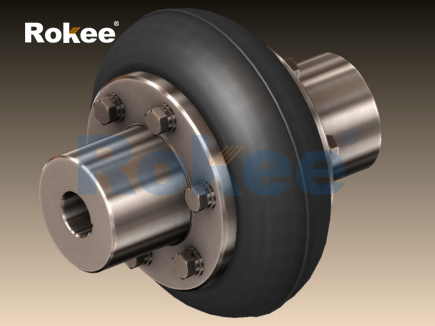
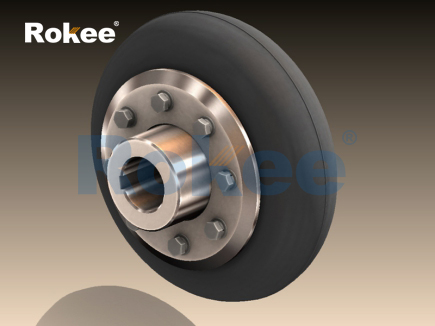
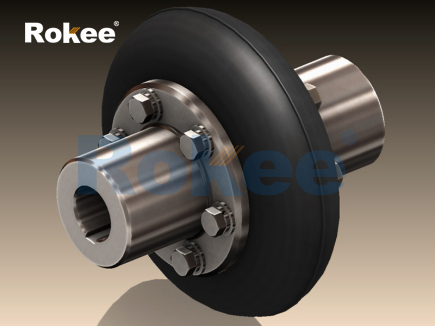
The flexible tyre coupling relies on the elastic deformation of a rubber tyre-shaped element to transmit torque between two rotating shafts, serving as a buffer between driving and driven equipment. At its core, power transfer does not depend on rigid metal contact alone, but on the twisting and bending resilience of the rubber tyre component fitted between two metal hubs. When the driving shaft rotates, rotational force acts on one hub, which pulls the outer edge of the rubber tyre, and the internal elastic structure of the tyre then transfers this rotational motion to the second hub connected to the driven shaft. Unlike fully rigid couplings that lock shafts into fixed relative positions, the rubber tyre can deform in multiple directions under load. This deformation allows the coupling to absorb small misalignments that inevitably appear during installation or operation, including radial, axial and angular offsets between the two shafts. As torque passes through the rubber material, internal friction within the polymer structure dissipates vibrational energy and sudden impact loads generated during startup, shutdown or fluctuating working conditions. This fundamental working principle separates it from rigid transmission designs, where shock loads pass directly along metal parts and accelerate wear on bearings, seals and other adjacent machine components. The rubber tyre element is designed to flex repeatedly without immediate fracture, enabling continuous operation under cyclic torque changes, though the range of allowable deformation has natural physical limits determined by the material properties of the elastic component. Even under steady rotation, minor shaft movement is accommodated smoothly, preventing binding and excessive stress concentration on individual metal parts of the coupling assembly.
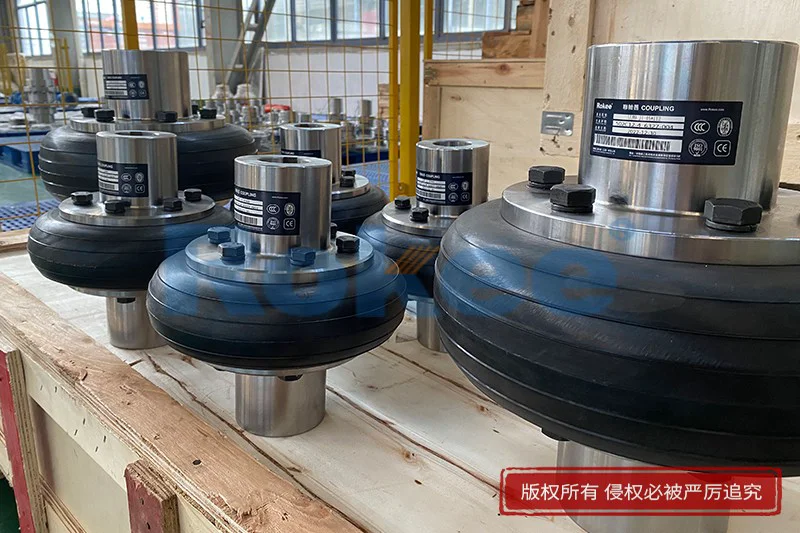
The structural layout of flexible tyre couplings directly supports their working mechanism, with three primary functional parts forming the complete assembly: two metallic hubs and one annular elastic tyre member. Each hub is mounted firmly onto the end of one shaft, usually secured through clamping or keyed connections to ensure no slipping between hub and shaft during rotation. The rubber tyre is sandwiched and fastened between these two hubs, creating a continuous connection that bridges the gap across the shaft separation. The tyre itself has a curved profile, which gives it the ability to stretch, compress and twist when torque is applied. When misalignment exists between the two shafts, the curved rubber body distorts rather than forcing the shafts back into perfect alignment. The metal hubs maintain a stable mounting geometry and transmit surface pressure evenly onto the tyre’s attachment edges, avoiding localized tearing that would occur if force was concentrated on a narrow strip of rubber. The assembly does not contain sliding or rolling internal parts, which eliminates friction wear between moving components inside the coupling itself. This simple construction means all dynamic flexibility comes solely from the elastic behaviour of the tyre. While the metal hubs resist shear forces and maintain shape under centrifugal force at operating speeds, the tyre bears the task of vibration damping and misalignment compensation. The connection points between tyre and hubs are engineered to distribute tensile stress evenly across the contact perimeter, reducing the risk of separation under repeated cyclic loads during long running periods.
Shaft misalignment compensation stands as one of the most critical functional outcomes of the coupling’s working principle, and it works through controlled elastic deflection of the rubber tyre. In practical machinery installations, perfect coaxial alignment between driving and driven shafts is nearly impossible to achieve and maintain over time. Thermal expansion of equipment frames, foundation settlement, bearing wear and routine assembly tolerances all introduce different forms of misalignment. Angular misalignment occurs when the centre lines of the two shafts intersect at an angle instead of running parallel. Radial misalignment describes the parallel offset where shaft centres sit side by side at a fixed distance. Axial misalignment refers to back-and-forth lengthwise movement of shafts along their rotational axis. The flexible tyre element can deform simultaneously in response to all three types of offset. As the shafts rotate, the tyre undergoes periodic stretching and compression in different sections around its circumference. Instead of transferring the reaction force of misalignment back into the shaft bearings, the rubber absorbs this movement through temporary shape change. This feature reduces bearing loads and lowers the risk of premature bearing fatigue. It is important to recognise that this compensation has defined boundaries. Excessive misalignment will create strain levels beyond the rubber material’s capacity, causing accelerated ageing, surface cracking or complete element failure. Operators must keep misalignment values within the practical working range to preserve service life and reliable torque transmission.
Vibration and shock absorption represents another key function derived from the elastic working principle of flexible tyre couplings. Many rotating machines experience transient torque spikes during startup, sudden load changes or emergency stop events. Without an elastic intermediary, these sharp force pulses travel instantly through rigid couplings to every connected component, creating mechanical vibration, noise and fatigue damage. The rubber tyre acts as a passive damping medium. When an impact load hits one hub, the rubber stretches gradually rather than transferring the shock instantaneously. Molecular movement within the rubber polymer converts part of the impact energy into low-grade heat, which dissipates into the surrounding air. This process softens sharp torque peaks before they reach the driven side of the system. Continuous periodic vibration, such as torsional oscillation from reciprocating equipment, is also attenuated by the tyre element. The coupling modifies the torsional natural frequency of the entire drive train, which can help the system avoid resonance conditions that would amplify vibration to destructive levels. The damping characteristic is inherent to the elastic material, requiring no extra hydraulic or mechanical damping devices. The amount of damping varies with rubber formulation, operating temperature and load magnitude. Higher operating temperatures tend to soften the rubber, altering both stiffness and damping performance over time. Regular inspection of the tyre surface can reveal signs of heat ageing, which gradually reduces the coupling’s ability to suppress vibration and shock loads.
Torsional torque transmission and load response describe how the flexible tyre coupling behaves under steady and variable torque during continuous rotation. Under normal steady working conditions, the tyre experiences uniform torsional shear as torque transfers from the driving hub to the driven hub. The rubber twists by a small, predictable angle proportional to the applied torque. This torsional deflection is often referred to as wind-up, which means there is a slight angular difference between the rotation of the two hubs under load. When the applied torque increases, the twist angle increases correspondingly within the elastic limit of the tyre. Once the load decreases, the rubber rebounds back to its original shape, returning the two hubs to their relative rest position. This reversible elastic behaviour differentiates it from rigid couplings with zero torsional deflection. Under fluctuating loads, the tyre continuously adjusts its twist angle to follow changing torque levels. The torsional stiffness of the tyre sets how much twist occurs for a given torque value. Softer rubber materials produce greater torsional deflection and better shock absorption, while stiffer formulations maintain more precise rotational synchronisation at the cost of reduced damping. If torque exceeds the maximum sustainable load of the tyre, permanent deformation can occur, meaning the rubber no longer returns to its original shape after load removal. Severe overload can tear the tyre along the stress concentration zones near the hub attachment points, interrupting torque transmission entirely and separating the driving and driven sides of the machine.
Centrifugal effects and rotational speed influence the working state of flexible tyre couplings during operation, adding secondary mechanical loads alongside torque and misalignment forces. As rotational speed rises, the mass of the rubber tyre experiences outward centrifugal force, which stretches the tyre radially and changes its preload and stiffness characteristics. At low operating speeds, centrifugal influence remains minimal, and performance is dominated by torque and misalignment deformation. At higher speeds, outward expansion of the tyre alters the contact pressure between the tyre and the hubs, and increases tensile stress on the outer portion of the rubber element. The coupling assembly must maintain dynamic balance during rotation. Minor mass imbalance from uneven tyre thickness or assembly offset creates additional cyclic radial forces that combine with existing vibration. These forces increase with the square of rotational speed, making high-speed operation more sensitive to imbalance and tyre material uniformity. Temperature also rises at elevated speeds because repeated flexing of the rubber generates internal heat. Heat buildup softens the polymer and accelerates oxidative ageing, shortening the usable life of the tyre element. For these reasons, the practical operating speed range is limited by the tyre material density, tensile strength and heat dissipation ability. Operation beyond the recommended speed envelope raises the chance of sudden element rupture, as centrifugal stress combines with torsional stress to push the rubber past its endurance limit.
Environmental factors modify the working principle and service behaviour of the rubber tyre element, changing its elastic response over the service life of the coupling. The polymer material of the tyre interacts with surrounding conditions, and these interactions gradually alter its flexibility and strength. Exposure to oils, grease and chemical solvents can penetrate the rubber structure, causing swelling, softening or loss of tensile strength. Direct ultraviolet radiation and ozone in air attack the outer surface of the tyre, initiating fine surface cracks that grow deeper under repeated flexing. High ambient temperatures speed up oxidation and polymer chain breakdown, while extremely low temperatures harden the rubber, making it brittle and reducing its ability to deform smoothly under shock and misalignment. Moisture generally has a milder effect, though prolonged exposure to humid environments can accelerate corrosion of the metal hubs, and rust particles at the contact interface may abrade the rubber edge. As the tyre ages, its elasticity decreases, stiffness increases and damping capacity drops. An aged coupling still transmits torque but loses much of its ability to absorb vibration and accommodate misalignment. Operators should observe surface conditions for cracking, blistering, hardening or permanent bulging. Replacing the elastic tyre element before failure protects the connected machinery from sudden disconnection and secondary damage caused by uncontrolled shaft movement once the coupling element breaks.
Maintenance considerations are closely tied to understanding the working principle of flexible tyre couplings, as all wear and failure modes originate from repeated elastic deformation of the tyre component. Unlike couplings with many moving metal parts, this design has no internal wearing surfaces that require lubrication, eliminating the need for regular grease or oil replenishment within the coupling itself. Most routine checks focus on inspecting the condition of the rubber tyre and verifying shaft alignment remains within acceptable limits. Visual inspection looks for surface cracks, separation from the hub attachments, permanent distortion or material loss. Periodic checks of shaft alignment help prevent excessive offset that would impose continuous high strain on the tyre and shorten its service life. The metal hubs typically experience slow wear only if the rubber element fails and metal-to-metal contact occurs. Once the tyre element becomes degraded, replacement can usually be completed without fully removing both connected machines, as the elastic tyre is the modular consumable part of the assembly. Proper storage of spare tyre elements also matters, since improper storage can age the rubber before installation. When correctly selected, installed and maintained, the flexible tyre coupling continues to transmit torque while mitigating shock, vibration and misalignment over a long operational period. Recognising that all its protective functions depend on the integrity of the elastic tyre helps maintenance teams identify early warning signs and schedule component replacement before unexpected downtime or equipment damage takes place.
- Tags:
- Flexible Tyre Couplings ,
- sandwich panel line ,
- sandwich panel machine
- pu sandwich panel machine
« Working Principle of Flexible Tyre Couplings » Latest Update Date: Oct 20, 2026
https://www.rokeecoupling.net/blog/working-principle-of-flexible-tyre-couplings.html