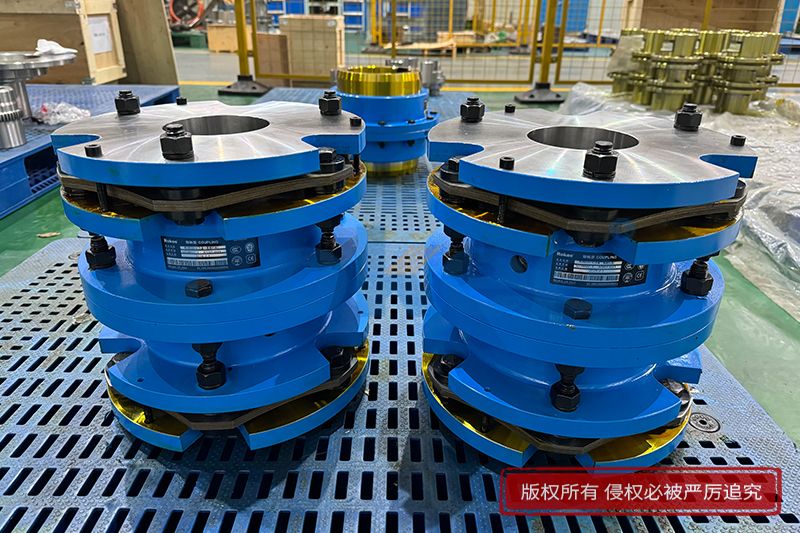
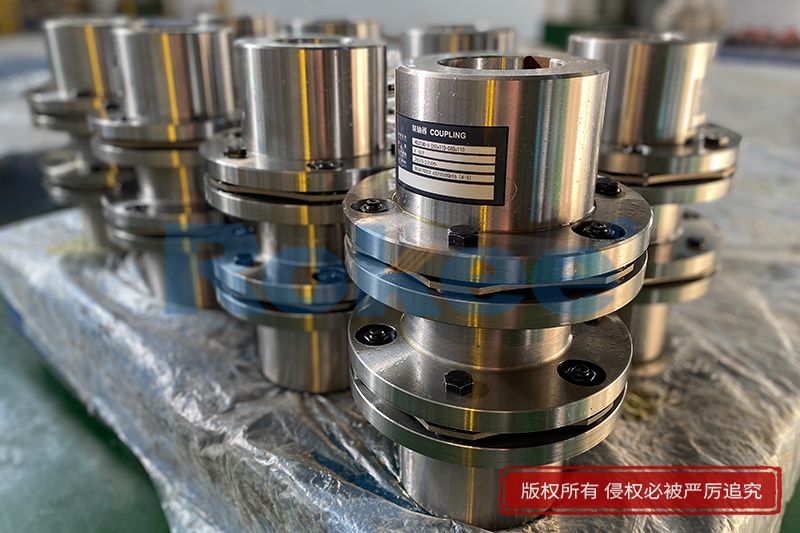
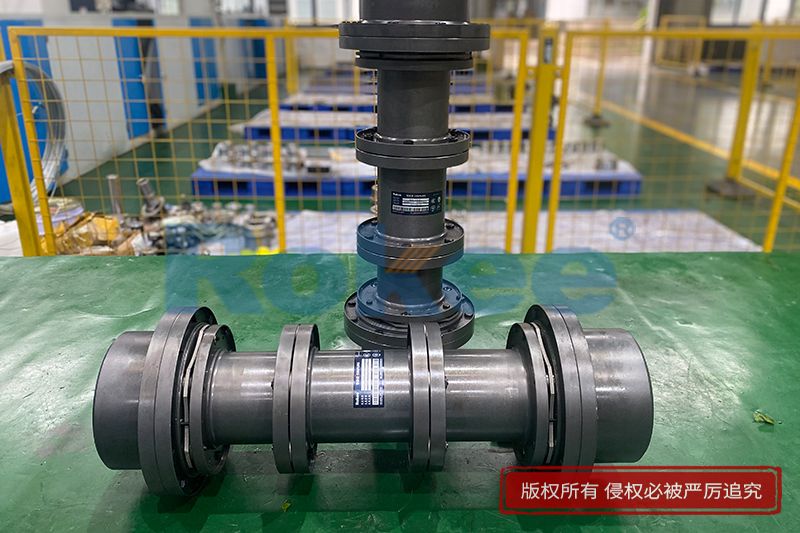
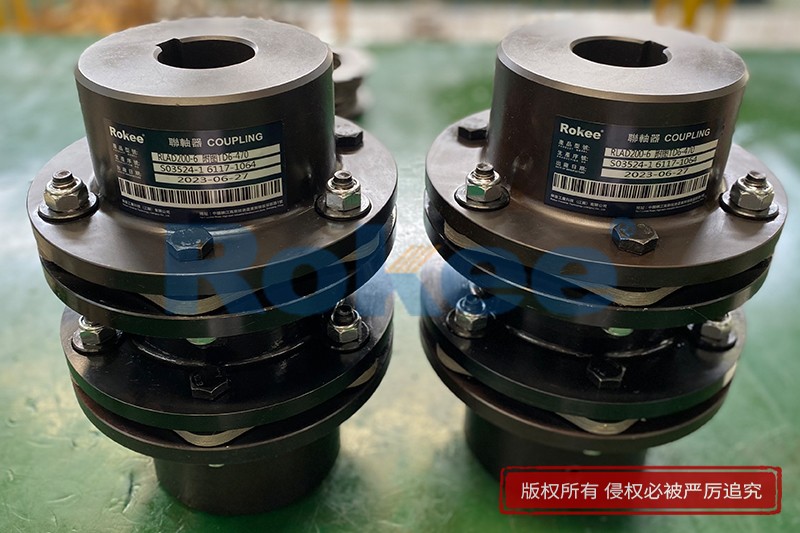
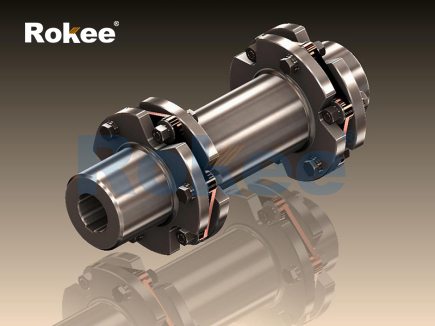
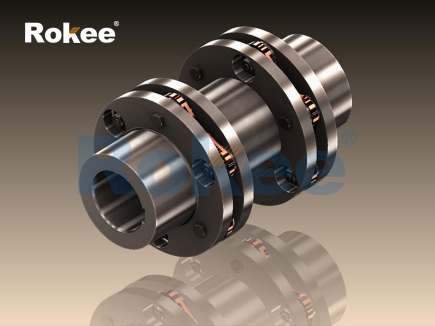
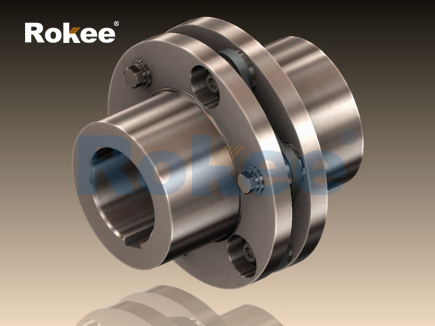
The flexible membrane coupling stands as a widely adopted mechanical connecting component used to transmit torque between two rotating shafts while accommodating multiple forms of misalignment that inevitably emerge in mechanical systems during operation. At its core, the working principle relies on the elastic deformation of thin metal membrane stacks, which serve as the key flexible medium linking the hub sections on both sides of the coupling. When the driving shaft rotates and delivers torque, force transfers from the driving hub through bolt fasteners to the layered membrane assembly, and then continues onward to the driven hub and the connected load shaft. Unlike rigid couplings that maintain fixed geometric relationships between shafts, the thin membranes can undergo controlled elastic bending and stretching without permanent deformation within the designed working range. This elastic characteristic allows the coupling to absorb slight axial displacement, angular inclination and parallel offset between the two shafts. Such misalignments often originate from manufacturing tolerances, assembly errors, thermal expansion of machine frames under operating temperatures, or gradual foundation settlement over long service periods. The membrane material is carefully selected to sustain repeated cyclic deformation, ensuring that deformation returns to its original state once external loads are removed. During each rotation cycle, the membranes experience alternating tensile and bending stresses, yet their thin stacked structure distributes stress evenly across the whole assembly, preventing concentrated stress points that would quickly cause component failure. The entire torque transmission process maintains continuous rotation, without gaps or sliding friction between contacting parts, so there is no wear generated from relative movement inside the coupling itself. This fundamental feature differentiates membrane couplings from other flexible types that depend on rubber or polymer elements, whose material properties degrade under sustained high temperature or continuous cyclic loading.
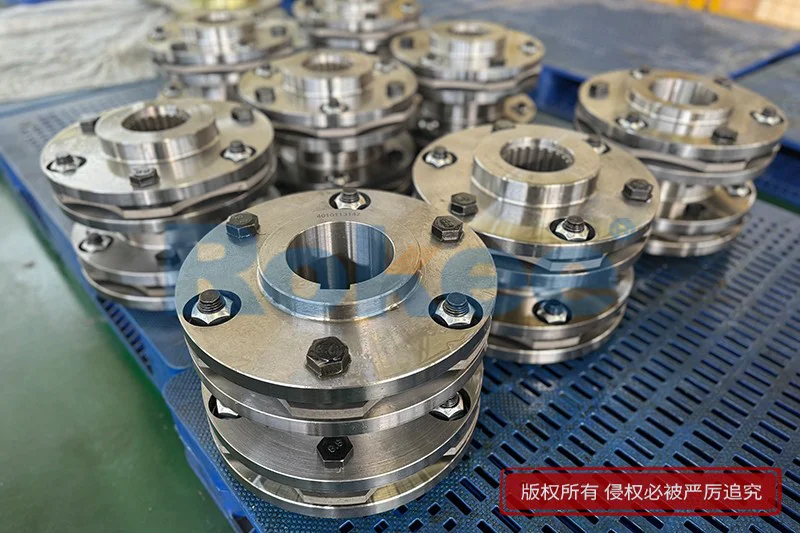
As torque passes through the membrane stack, each individual membrane plate collaborates to bear mechanical loads, and the arrangement of stacked membranes directly influences how deformation and stress distribute across the coupling structure. Multiple thin membranes are piled together with narrow gaps between adjacent plates, and all membranes are secured at their inner and outer circumferences by fasteners connecting to the driving and driven hubs respectively. When angular misalignment exists between the two shafts, one side of the membrane stack stretches while the opposite side compresses in each rotational cycle. This cyclic elastic distortion adjusts the angular difference between shaft ends smoothly rather than forcing the shafts into perfect coaxial alignment. In the case of axial displacement, the membranes bend along the axial direction to compensate for the movement of one shaft toward or away from the other, and the bending amplitude is restricted by the design limits to avoid exceeding the material’s elastic threshold. Parallel misalignment creates a combined state of angular and axial deformation across the membrane group, where different sections of the membrane stack take turns to bear tensile stress as the assembly spins. The stacking design spreads total load over many thin plates instead of concentrating force on a single thick piece of metal. A single thick plate would develop sharp stress peaks under slight deformation and crack easily, whereas thin stacked membranes share loads and reduce peak stress values effectively. The fasteners clamping the membranes must hold every plate tightly at the connection points to prevent individual membranes from slipping relative to one another. Any micro-slip between membranes would introduce friction, generate heat and accelerate fatigue damage, so the preload of fasteners is maintained to preserve unified movement of the entire stack during rotation. All these coordinated deformations occur instantaneously as rotation proceeds, and the coupling does not interrupt torque transfer while continuously compensating for shaft position changes.
The dynamic response of flexible membrane couplings during rotation is closely tied to vibration suppression, a critical benefit brought by the elastic membrane structure. Every rotating mechanical system contains inherent vibration induced by uneven load distribution, slight mass imbalance of rotating parts, or fluctuating torque from power sources. Rigid couplings transmit all vibration directly from the driving side to the driven side, allowing vibration waves to propagate unimpeded along the shaft system and amplify resonance risks under certain operating speeds. The membrane assembly functions as an elastic buffer, filtering part of the vibrational energy through its reversible deformation. When transient torque spikes occur, such as during startup, sudden load changes or short impact loads, the membranes briefly deform to absorb shock energy instead of instantly passing the full impact to the connected equipment. However, this vibration buffering capacity has clear boundaries. Large and frequent impact loads will drive membrane deformation past the elastic range, leading to plastic deformation and permanent distortion of the plates. In continuous steady-state operation, the elasticity of membranes changes the natural vibration frequency of the whole shaft system. Engineers analyze this frequency characteristic to avoid operating speeds that match the system’s resonant frequency, which would create amplified cyclic stress on the membranes and lead to rapid fatigue fracture. The cyclic stress experienced by membranes repeats with every full rotation, forming high-cycle fatigue loading. Even under seemingly stable working conditions, repeated tension and bending slowly accumulate fatigue damage over countless rotation cycles. Therefore, the dynamic behavior must be evaluated alongside expected operating duration, to ensure the coupling can withstand millions or billions of cyclic load variations without failure. The damping effect of metal membranes remains relatively low compared with elastomer couplings, which means membrane couplings cannot eliminate all vibration, but they avoid the aging and hardening problems common to non-metallic flexible materials.
Heat generation within flexible membrane couplings mainly arises from internal stress cycling and minor energy loss during repeated elastic deformation, and understanding thermal behavior helps predict long-term performance. When membranes deform and recover in every rotation cycle, a tiny fraction of mechanical energy converts into heat through material hysteresis. This heat accumulates within the membrane stack, especially under high rotational speeds and heavy torque loads. Unlike couplings with rubber components, metal membranes retain stable mechanical properties across a much wider temperature range and will not soften, melt or lose elasticity at moderately elevated working temperatures. Still, excessive temperature rise alters material fatigue resistance and accelerates the progression of tiny surface cracks. Heat dissipates outward from the membrane stack through convection with surrounding air and thermal conduction through the connected hubs and shafts. In enclosed equipment spaces with limited airflow, heat cannot escape efficiently, causing operating temperature to climb continuously. The amplitude of membrane deformation also affects heat output; larger misalignment increases the bending range of membranes in each rotation and raises hysteresis heat production. Operators must keep actual misalignment within the recommended working limits not merely to protect against overload, but also to control thermal buildup. Thermal expansion of the connected shafts and machine casings creates additional axial misalignment, forming a mutual influence loop: temperature change shifts shaft positions, which increases membrane deformation and generates more heat. This interaction must be considered when setting up the initial alignment during installation. Continuous high temperature operation gradually reduces the safety margin against fatigue failure, shortening the usable service life of the membrane stack if operating conditions remain unadjusted.
Installation alignment has a profound impact on the working state and service life of flexible membrane couplings, because the membranes are engineered only for limited controlled deformation. Before the coupling is fully assembled, the two shafts are positioned as close to coaxial as possible to minimize the baseline misalignment that the membranes need to compensate. Even with careful adjustment, perfect zero misalignment cannot be achieved, so the membranes will always carry a small amount of deformation once the system starts rotating. If parallel offset or angular inclination exceeds the acceptable working range, the cyclic bending and tension on membranes becomes excessive. Over time, this excessive cyclic stress creates microcracks starting at fastener holes or the edges of membrane plates, the locations where stress tends to concentrate. Axial positioning also requires precise handling; excessive pre-compression or tension on the membrane stack during assembly imposes static stress on membranes before the equipment even begins running. This static load adds on top of dynamic stress from rotation and torque transmission, lowering the threshold for fatigue crack initiation. During assembly, fasteners are tightened in a specified sequence to apply uniform clamping force across the membrane stack. Uneven tightening can warp individual membranes and introduce extra localized stress. After installation, initial rotation should proceed at low speed for inspection to check for abnormal noise or temperature rise, which serve as indicators of poor alignment. Even if alignment meets requirements at the time of installation, operating conditions shift over time. Bearing wear, foundation movement and thermal expansion alter shaft positions gradually, slowly increasing misalignment. Regular inspection helps detect growing misalignment before it creates irreversible damage to the membrane assembly. Correct installation does not eliminate misalignment entirely; its purpose is to reduce misalignment to a level that the membranes can safely accommodate throughout the expected service cycle.
Failure modes of flexible membrane couplings are mostly related to fatigue of the membrane plates, and recognizing these failure paths supports better operational monitoring. The most common failure occurs when cyclic tensile and bending stress creates fatigue cracks that grow slowly across the membrane material. Cracks usually originate around bolt holes, as these holes create geometric discontinuities that concentrate stress. As the equipment continues to run, cracks extend outward across the membrane surface until one or more plates rupture completely. In some cases, only part of the stacked membranes breaks at first, allowing the coupling to keep transmitting torque for a limited time while the remaining intact membranes bear extra load. This creates a warning window before total coupling breakdown, unlike rigid couplings that often fail suddenly with no advance signs. Another failure type comes from excessive misalignment causing large plastic deformation, where membranes no longer return to their original flat shape after load removal. Once plastic deformation occurs, the coupling loses its designed flexibility and alignment compensation function permanently. Corrosion also contributes to membrane degradation. Exposure to moisture, chemical vapors or corrosive fluids creates pitting on the membrane surface. These pits act as stress raisers and accelerate crack development under cyclic loading. Foreign particles trapped between stacked membranes can scratch plate surfaces, producing tiny notches that behave similarly to corrosion pits. Improper fastener preload can also trigger failure. Insufficient clamping force allows membranes to slide against each other, creating fretting wear at contact surfaces and forming fine cracks. Over-tightening, by contrast, introduces heavy static compression stress and risks crushing or warping the thin plates. Monitoring changes in vibration amplitude, operating noise and surface temperature can help identify early signs of membrane degradation, so maintenance actions can be scheduled before unexpected shutdowns happen.
Compared with other types of flexible couplings, flexible membrane couplings show distinct advantages and inherent limitations determined by their metal membrane working principle. Elastomer couplings use rubber or polymer blocks to provide flexibility, and they offer strong damping capacity to absorb heavy shock loads. However, polymer materials degrade with heat, ultraviolet radiation, oil contamination and aging, so their performance declines steadily over time and they require frequent replacement. Gear couplings compensate misalignment through sliding contact between gear teeth, but sliding movement creates friction and wear, demanding regular lubrication and maintenance. Chain couplings rely on roller chains to transfer torque, and they generate noise and backlash during rotation. Membrane couplings transmit torque through elastic deformation of solid metal plates without relative sliding between internal components. This design removes the need for lubrication, reducing routine maintenance tasks significantly. They can operate steadily at high rotational speeds and maintain stable performance in high-temperature environments where polymer materials cannot survive. Their backlash-free torque transfer suits applications requiring precise rotational synchronization between shafts. Nevertheless, the metal membrane structure has weaker shock absorption capability. Heavy repeated impact loads will quickly induce fatigue damage to the membranes, making them less suitable for equipment with frequent large torque shocks. The allowable misalignment range is also relatively modest compared with elastomer couplings. If substantial shaft displacement is expected during operation, membrane couplings may not be the optimal selection. Understanding these trade-offs helps match membrane couplings with appropriate equipment, maximizing their strengths while avoiding operating conditions that push the components beyond their designed capability.
Looking forward, improvements to flexible membrane couplings continue to center on refining membrane material properties and structural layout, building on the fundamental working principle of elastic deformation for torque transmission and misalignment compensation. Advanced material processing techniques enhance the fatigue resistance of thin membrane plates, enabling the coupling to endure more stress cycles while retaining good elasticity. Refined surface treatment methods reduce surface defects and improve resistance against corrosion and fretting damage, extending the service life of membrane stacks under harsh operating environments. Optimized hole geometry and edge finishing lower stress concentration around fastener positions, delaying the formation of fatigue cracks. Structural adjustments to the stacking arrangement and membrane plate profiles allow engineers to tune the coupling’s stiffness characteristics. Tunable stiffness expands the range of usable operating speeds and offers better adaptation to varied shaft system dynamic requirements. Digital monitoring methods also develop alongside mechanical design. Sensors can track vibration, temperature and shaft position changes in real time, capturing subtle shifts in coupling operating condition that signal rising misalignment or early membrane fatigue. This data supports predictive maintenance, replacing fixed periodic inspection schedules with condition-based service arrangements. Even with these technical upgrades, the core working principle remains unchanged: torque transfers through elastic deformation of stacked thin metal membranes, which accommodate controlled shaft misalignment without sliding friction. Future developments will not abandon this basic mechanism but will expand its operational boundaries, helping flexible membrane couplings serve more demanding rotating machinery systems reliably and efficiently. As rotating equipment pursues higher speed, greater power density and longer continuous running periods, membrane couplings will continue to be a vital connecting element that balances stable torque transmission, misalignment compensation and low maintenance requirements.
- Tags:
- Flexible Membrane Couplings ,
- sandwich panel line ,
- sandwich panel machine
- pu sandwich panel machine
« Working Principle of Flexible Membrane Couplings » Latest Update Date: Oct 20, 2026
https://www.rokeecoupling.net/blog/working-principle-of-flexible-membrane-couplings.html