Cardan Shaft of 4000mm Plate Main Mill
Rokee is a well-known Cardan Shaft supplier from china, the page show cases of Cardan Shaft of 4000mm Plate Main Mill, provide customized services based on user's drawings, and supporting exports.
In the heavy metallurgical rolling industry, large-scale plate rolling mills serve as core processing equipment for producing extra-wide metal plates, and the 4000mm plate main mill stands out for its capability to process ultra-wide steel plates that meet the demands of engineering construction, shipbuilding, and energy equipment manufacturing. As an indispensable power transmission component of this heavy-duty rolling mill, the cardan shaft undertakes the critical task of transmitting torque between the driving device and the rolling rolls, ensuring the stable and continuous operation of the rolling process under complex and harsh working conditions. Unlike ordinary transmission shafts used in light industrial machinery, the cardan shaft configured for the 4000mm plate main mill features oversized structural dimensions, excellent load-bearing performance, and strong environmental adaptability, which are tailored to the high-torque, heavy-load, and high-impact operating characteristics of large plate rolling equipment. Its structural rationality, operational stability, and service life directly determine the production efficiency, processing accuracy, and operational safety of the entire rolling mill production line, making it a key basic component that cannot be ignored in the heavy plate rolling system.

The operating environment of the cardan shaft in the 4000mm plate main mill is extremely rigorous, which puts forward stringent requirements for its overall structural design and material performance. During the plate rolling process, the mill needs to squeeze and deform thick metal blanks with great extrusion force, generating instantaneous impact loads and fluctuating torque throughout the transmission system. The ultra-wide rolling width of 4000mm means that the rolling rolls have a large span, and the connecting transmission components need to adapt to the angular displacement and axial deviation generated by the slight deformation of the frame and the vibration of the rolls during operation. In addition, the internal space of the rolling mill is filled with rolling dust, oxide scale, and cooling water mist, and the long-term high-load operation will cause continuous temperature rise of the transmission parts. Such a complex working environment requires the cardan shaft to possess outstanding mechanical strength, vibration resistance, corrosion resistance, and deformation resistance, so as to avoid transmission failure caused by structural fatigue or environmental erosion during long-term continuous operation.
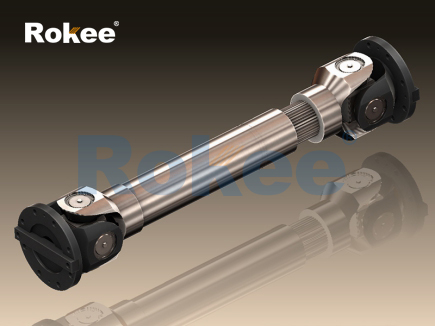
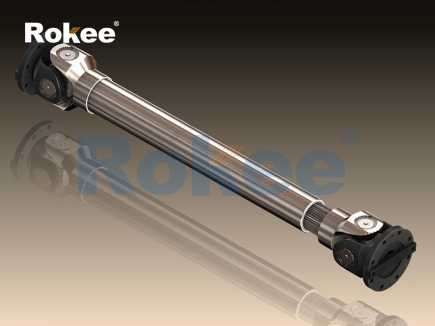
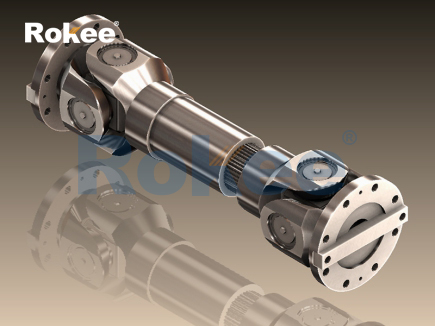
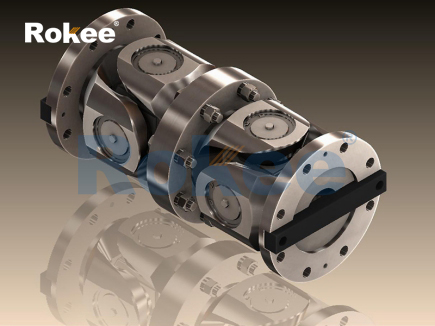
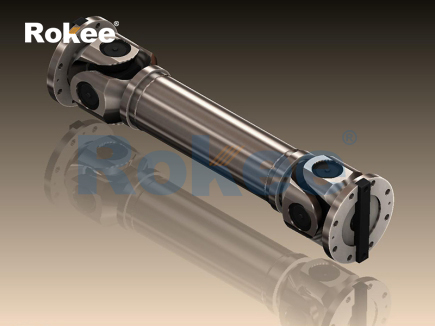
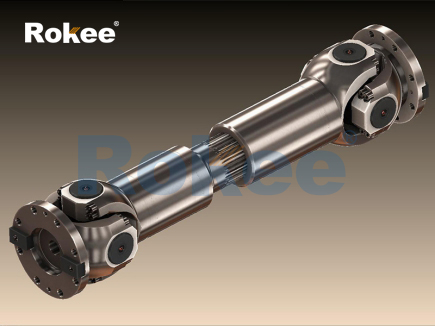
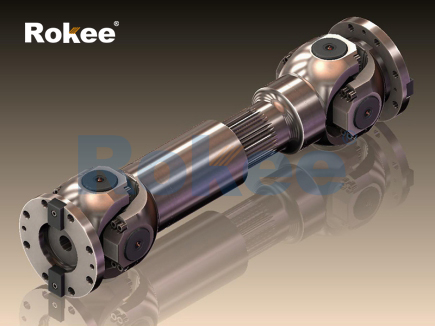
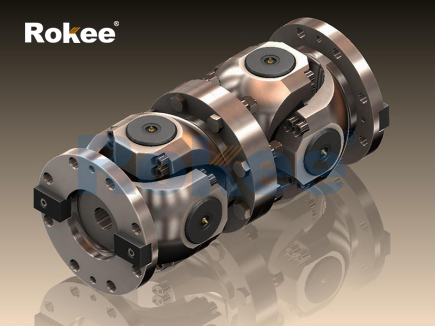
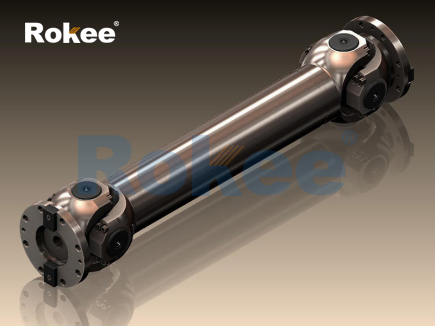
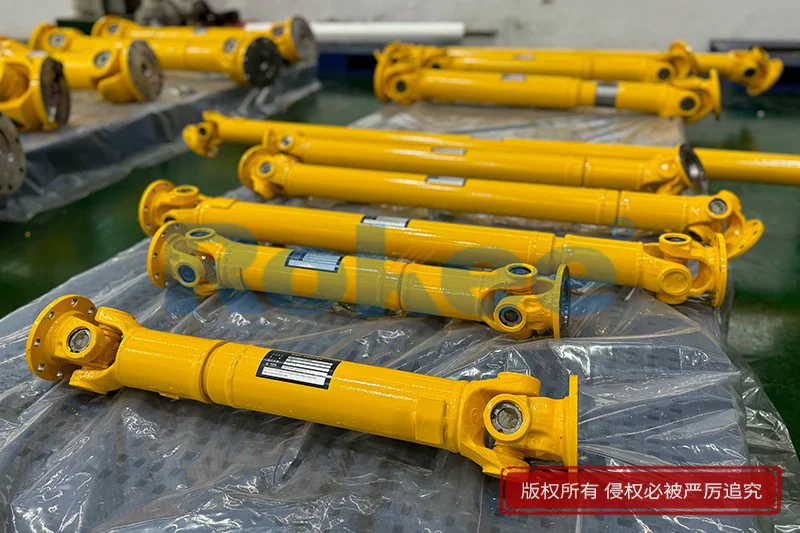
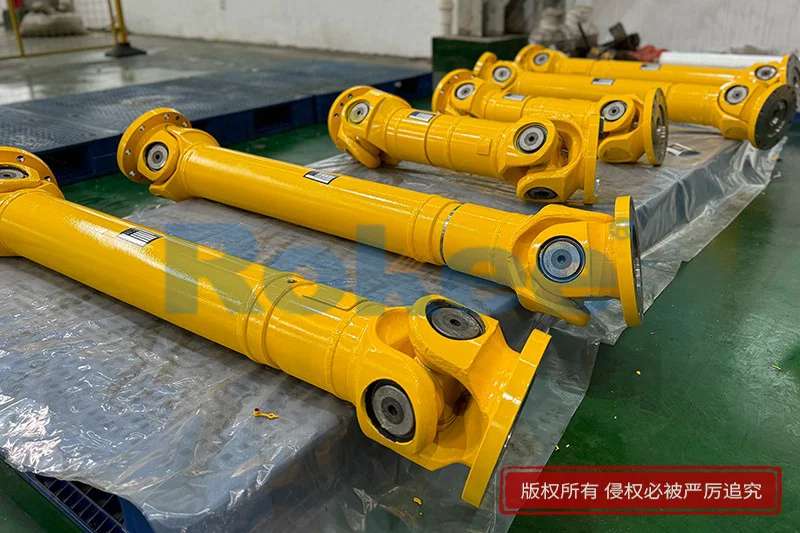
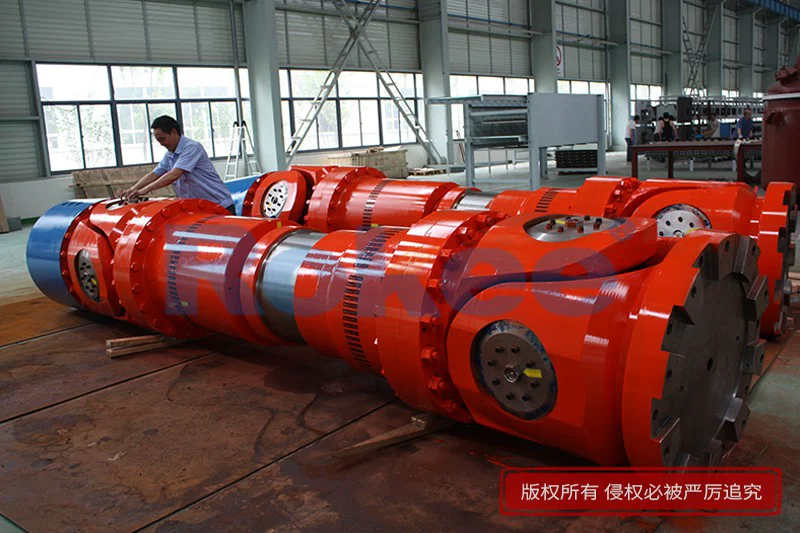
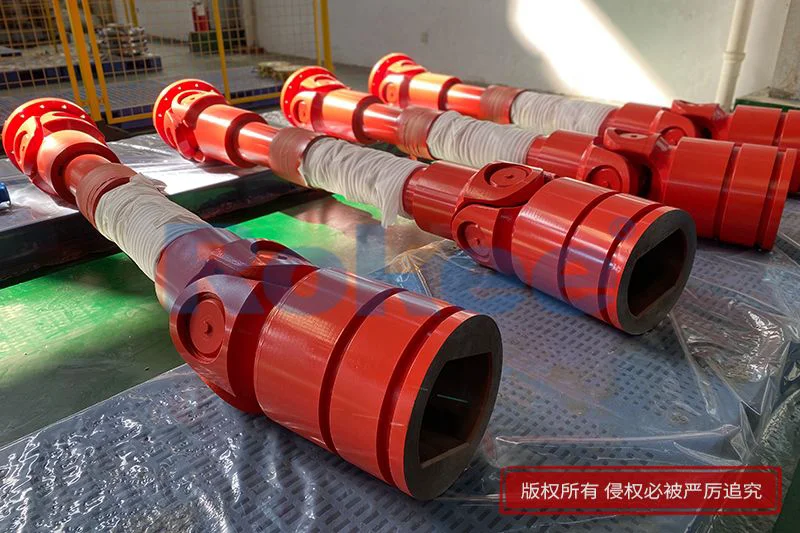
The overall structure of the cardan shaft for the 4000mm plate main mill adopts a mature heavy-duty universal coupling structure, which is mainly composed of universal joint assemblies, intermediate shaft body, connecting flanges, and telescopic adjustment structures. Each component has a clear functional division and closely cooperates to complete the power transmission work. The universal joint assemblies are arranged at both ends of the shaft body, which are the core functional parts to realize angular transmission. Each universal joint is equipped with a cross shaft and a roller bearing structure. The cross shaft connects the fork heads at both ends, and the roller bearings are evenly distributed around the cross shaft to reduce friction resistance during rotational movement. This structural design enables the cardan shaft to maintain stable torque transmission when there is a certain angular offset between the driving shaft and the driven shaft, effectively compensating for the position deviation caused by equipment vibration and mechanical deformation.
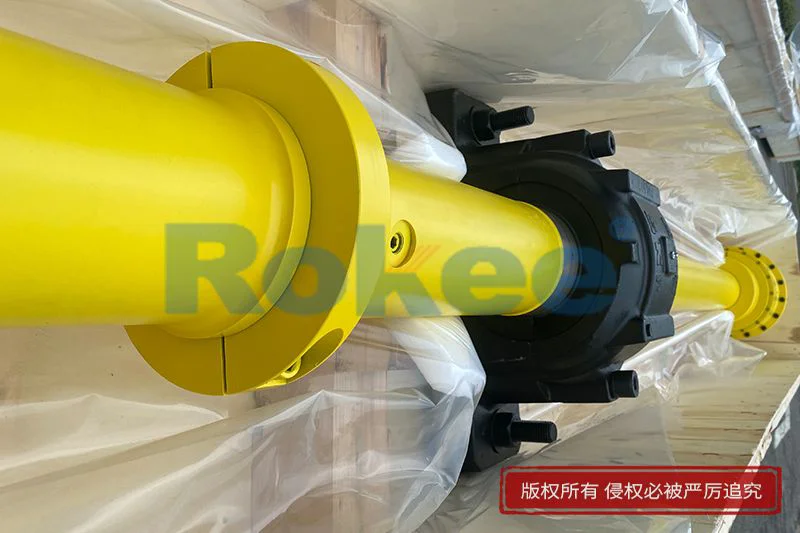
The intermediate shaft body is the main load-bearing part of the cardan shaft, and it adopts an integrated forging molding process in the production and processing stage. The shaft body has a thick and solid wall thickness and a streamlined outer contour, which can effectively disperse the concentrated stress generated during torque transmission and avoid local fracture caused by stress accumulation. Considering the assembly and displacement adjustment requirements of the rolling mill equipment, a telescopic matching structure is designed in the middle section of the shaft body. The internal spline meshing structure is used to realize the free expansion and contraction of the shaft body within a certain stroke range. This design can compensate for the axial displacement between the driving end and the driven end during the rolling mill startup, shutdown, and load switching processes, preventing rigid extrusion and structural damage between transmission components. The connecting flanges at both ends of the cardan shaft are processed with high-precision bolt holes and positioning grooves, which can realize tight connection with the driving motor reducer and the rolling roll transmission base. The flat fitting surface ensures the uniformity of force bearing during rotation, avoiding connection loosening caused by eccentric vibration.
The working principle of the cardan shaft in the 4000mm plate main mill follows the mechanical transmission logic of universal angular torque transmission. When the rolling mill starts to operate, the power generated by the driving motor is decelerated and torque-increased by the reducer, and then the torque is stably transmitted to the cardan shaft through the flange connection structure. The universal joint at one end of the shaft body receives the rotational power and drives the cross shaft to rotate. Under the coordination of the roller bearings, the cross shaft drives the fork head and the intermediate shaft body to perform synchronous rotational motion. Subsequently, the universal joint at the other end transmits the torque to the driven rolling roll, driving the roll to rotate at a constant speed to complete the extrusion and rolling processing of metal plates. In this process, when the rolling mill produces mechanical vibration or roll position deviation due to metal blank extrusion, the universal joints at both ends can flexibly adjust the transmission angle, and the telescopic spline structure can adapt to the axial distance change, ensuring that the torque transmission process is always smooth without rigid jamming.
In the actual rolling production process, the cardan shaft needs to adapt to diverse rolling working conditions to maintain stable transmission performance. In the stage of thick blank feeding, the instantaneous contact resistance between the metal blank and the rolling roll increases sharply, bringing sudden impact torque to the cardan shaft. At this time, the excellent structural rigidity of the shaft body and the buffer performance of the universal joint can absorb part of the impact force, preventing the instantaneous overload from causing structural damage to the transmission components. During the continuous rolling of medium-thickness plates, the load of the rolling mill remains relatively stable, and the cardan shaft maintains high-efficiency and low-loss rotational transmission. The evenly distributed bearing structure can reduce rotational friction, lower the temperature rise of the shaft body, and avoid performance attenuation caused by high-temperature thermal deformation. In the rolling stage of ultra-wide thin plates, the running speed of the rolling roll increases slightly, and the cardan shaft needs to maintain good dynamic balance to suppress rotational vibration and ensure the flatness and thickness uniformity of the processed metal plates.
Long-term high-load operation will inevitably cause different degrees of wear and fatigue loss of the cardan shaft, and the main wear parts are concentrated in the universal joint bearings, cross shaft surfaces, and spline meshing areas. The rolling dust and oxide scale in the working environment will adhere to the bearing friction pairs, increasing the abrasion degree of the contact surface and reducing the flexibility of bearing rotation. The repeated alternating torque will cause tiny fatigue cracks on the surface of the cross shaft and the shaft body. If not detected and maintained in time, the cracks will gradually expand and eventually lead to shaft body fracture. In addition, the long-term vibration of the equipment may cause slight loosening of the connecting flange bolts, resulting in eccentric force on the shaft body during rotation, aggravating local wear and vibration noise. Understanding the failure causes and wear rules of the cardan shaft is of great significance for formulating scientific maintenance plans and prolonging the service life of components.
Daily maintenance and scientific management are essential to keep the cardan shaft of the 4000mm plate main mill in good operating condition. The lubrication maintenance work should be carried out regularly for the universal joint bearings and spline meshing parts. High-viscosity and high-temperature resistant lubricating grease is selected to fill the internal gaps of the friction pairs, which can reduce metal friction loss and form a protective oil film to isolate external dust and cooling water mist. The sealing components at the joints of the shaft body need to be inspected regularly. Aging and damaged sealing rings should be replaced in a timely manner to prevent corrosive impurities from entering the interior of the shaft body and eroding the internal structural parts. During the regular shutdown maintenance period, staff should use professional testing equipment to detect the surface cracks and deformation of the shaft body, and check the tightness of the flange connecting bolts to eliminate potential safety hazards such as loose connection and structural fatigue.
In addition to daily maintenance, the optimization and upgrading of the cardan shaft also help to improve the overall operating performance of the rolling mill. In terms of material selection, high-strength alloy forged materials can be used to replace ordinary carbon steel. Through reasonable heat treatment processes such as quenching and tempering, the hardness, toughness, and fatigue resistance of the shaft body are improved, so that it can withstand greater impact torque. In terms of structural optimization, the surface of the spline and cross shaft can be treated with wear-resistant coating to enhance surface wear resistance and reduce the frequency of component replacement. The dynamic balance calibration technology is adopted in the finished product processing stage to reduce the vibration amplitude of the shaft body during high-speed operation, improve the transmission stability, and further reduce the additional load caused by vibration.
From the perspective of the entire heavy plate rolling industry, the cardan shaft is a vital link in the power transmission chain of the 4000mm plate main mill. Its reliable operation ensures the continuity of the rolling production line, reduces the shutdown maintenance time caused by transmission component failure, and improves the overall production capacity of the enterprise. The stable torque transmission performance can maintain the rotational synchronization of the upper and lower rolling rolls, effectively control the processing tolerance of ultra-wide metal plates, and improve the surface quality and dimensional accuracy of finished plates. For the metallurgical processing industry that pursues high efficiency and high precision, the performance optimization and maintenance upgrading of the cardan shaft are important means to reduce production costs and improve product competitiveness.
With the continuous progress of heavy machinery manufacturing technology, the design and processing technology of heavy-duty cardan shafts are also constantly innovating. The future development direction of the cardan shaft for the 4000mm plate main mill lies in lightweight structure, intelligent monitoring, and long-life durability. On the premise of ensuring mechanical strength, the optimized hollow shaft body structure is adopted to reduce the self-weight of components and lower the rotational energy consumption. The built-in sensing elements can monitor the operating parameters such as torque, vibration amplitude, and temperature of the shaft body in real time, realize early warning of abnormal operating conditions, and improve the intelligent level of equipment maintenance. At the same time, the application of new wear-resistant and corrosion-resistant materials will further extend the service cycle of the cardan shaft, reduce the replacement frequency of vulnerable parts, and create greater economic benefits for industrial production.
In conclusion, the cardan shaft is an irreplaceable core transmission component of the 4000mm plate main mill. Its unique structural design adapts to the harsh working conditions of heavy load, high impact, and complex environment in the plate rolling process. Through reasonable power transmission and displacement compensation functions, it ensures the efficient and stable operation of the rolling mill equipment. Scientific daily maintenance and continuous structural optimization can effectively reduce component wear, prolong service life, and improve the comprehensive operating performance of the rolling mill. In the field of heavy metal plate processing, continuous in-depth research on the structural performance, maintenance technology, and innovative upgrading of heavy-duty cardan shafts will help promote the high-quality development of the metallurgical rolling industry, and provide reliable technical support for the production of high-performance ultra-wide metal plates.
With excellent quality, we have been continuously providing many coupling products of various categories and uses complying with multiple standards and a full range of services, from the product selection to final installation and operation, for the industry fields of ferrous metallurgy, nuclear power, gas turbine, wind power, ropeway construction, lifting transportation, general equipment, etc.
pu sandwich panel line,pu sandwich panel machine,sandwich panel machine
« Cardan Shaft of 4000mm Plate Main Mill » Latest Update Date: May 9, 2026
https://www.rokeecoupling.net/cases/cardan-shaft-of-4000mm-plate-main-mill.html